Just Ship It Logistics coordinated specialized heavy equipment transport for a Liebherr 952 crawler excavator, using a multi-axle RGN lowboy trailer for a proposed 3,400 km relocation from Toronto, Ontario, to Calgary, Alberta.
The customer needed to relocate a large tracked excavator between construction job sites. Because of the machine’s substantial weight, steel tracks, and extended boom assembly, conventional freight transportation was not suitable.
The project required specialized heavy-haul trucking equipment, appropriate cargo securement, and transportation planning that accounted for the machinery’s dimensions and weight distribution.
Just Ship It Logistics arranged an RGN lowboy transportation solution tailored to the excavator’s requirements.
Detail
Project Information
Project Type
Long-distance heavy equipment transport
Industry
Construction and heavy machinery
Origin
Toronto, Ontario
Destination
Calgary, Alberta
Transportation Distance
Approximately 3,400 km
Cargo
Liebherr 952 crawler excavator
Number of Loads
1 excavator
Transportation Equipment
Multi-axle RGN lowboy trailer
Trailer Configuration
Removable gooseneck / lowbed trailer
Cargo Securement
Heavy-duty chains and binders
Transportation Scope
Interprovincial heavy equipment hauling
Main Challenge
Relocating a large tracked excavator over a long distance
Just Ship It Logistics’ Role
Specialized trailer selection and heavy-haul transportation coordination
Project Objective
Relocate construction machinery between job sites
Project Result
Specialized RGN lowboy transportation solution arranged for the excavator
What Did This Liebherr Excavator Relocation Involve?
The customer required transportation for a Liebherr 952 crawler excavator from a construction site in Toronto, Ontario, to another location in Calgary, Alberta.
The proposed route covered approximately 3,400 km and involved long-distance equipment hauling across multiple Canadian provinces.
Unlike conventional freight, the excavator could not simply be loaded into an enclosed trailer or transported using standard equipment.
Its steel tracks, substantial operating weight, and large boom assembly required specialized heavy equipment transport.
The customer needed a transportation solution that could accommodate the excavator’s dimensions, support its weight, and provide appropriate loading and securement arrangements.
Just Ship It Logistics coordinated a multi-axle RGN lowboy trailer suited to these requirements.
The selected configuration provided a low-profile transportation platform designed for large construction machinery.
For this project, selecting the appropriate trailer was one of the most important elements of the transportation plan.
How Did Just Ship It Logistics Address the Excavator Transport Challenges?
For this Liebherr 952 excavator relocation, Just Ship It
Logistics selected a multi-axle RGN lowboy trailer to
address four key transportation challenges.
01
Accommodating Loading Requirements
We arranged a removable gooseneck trailer designed
to provide ground-level loading access. This
configuration was suited to the excavator’s tracked
undercarriage and reduced reliance on elevated
loading infrastructure.
02
Managing Transport Height
The lowbed configuration helped minimize the
machinery’s overall loaded height, an important
consideration when planning a long-distance
shipment involving bridges and other overhead
clearances.
03
Supporting Heavy Machinery
The multi-axle RGN provided a heavy-duty platform
suited to the excavator’s weight and dimensions.
Equipment positioning and axle-weight distribution
were key considerations in selecting the trailer.
04
Securing the Excavator
The transportation setup incorporated heavy-duty
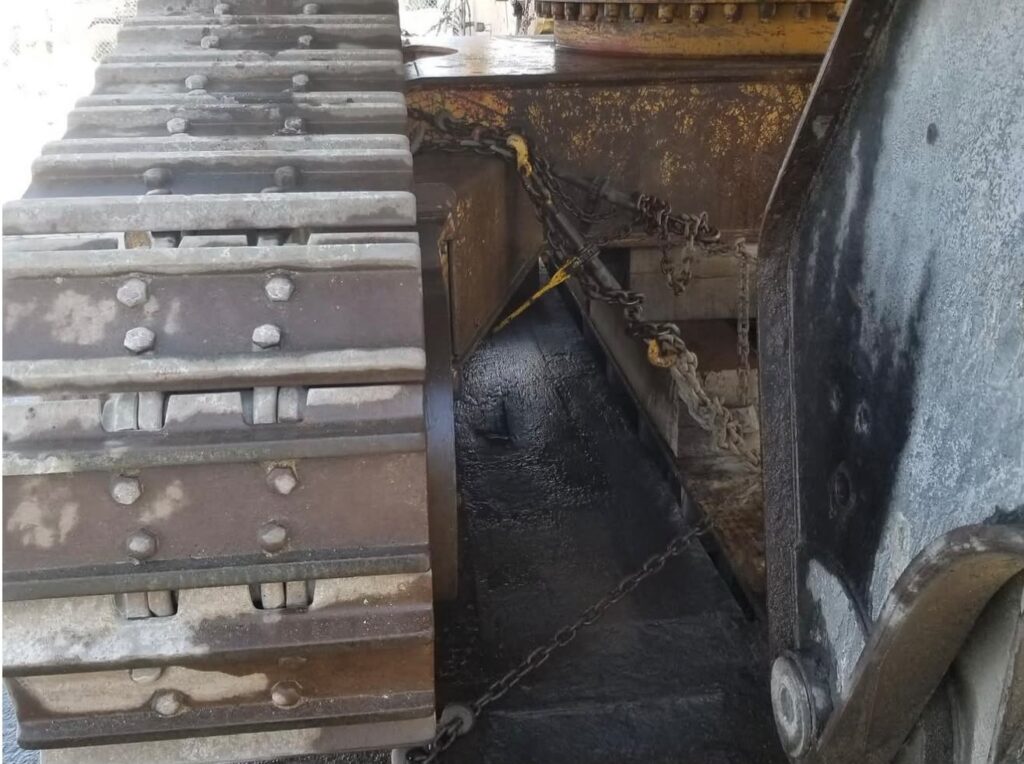
chains and binders. Project photographs show the
excavator positioned on the lowboy trailer with
chain securement for the heavy tracked machinery.
✓
The customer benefit:
Just Ship It Logistics coordinated a specialized
heavy equipment hauling solution tailored to the
Liebherr excavator’s requirements, avoiding reliance
on conventional freight equipment.
How Was the Liebherr Excavator Positioned and Secured?
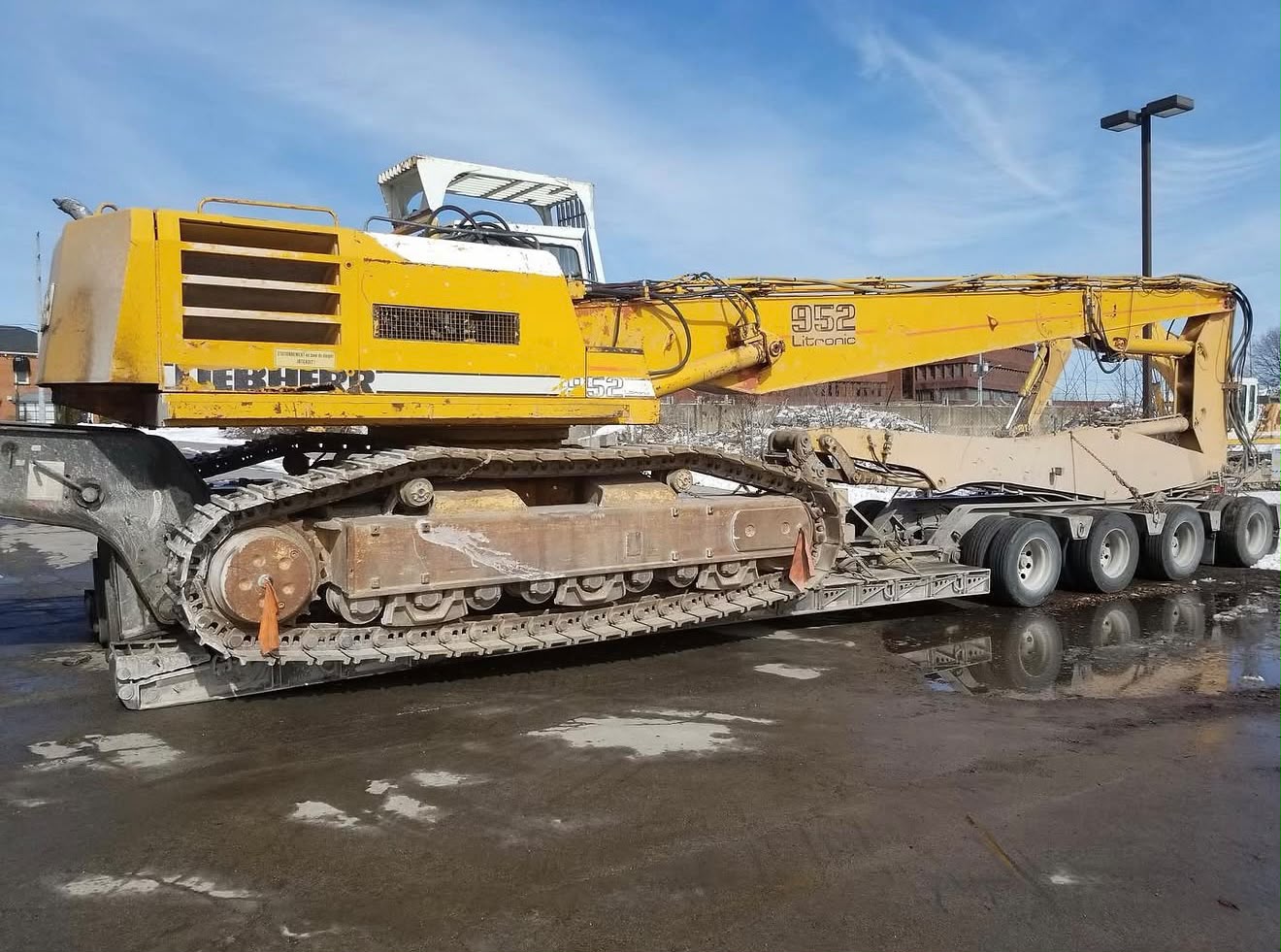
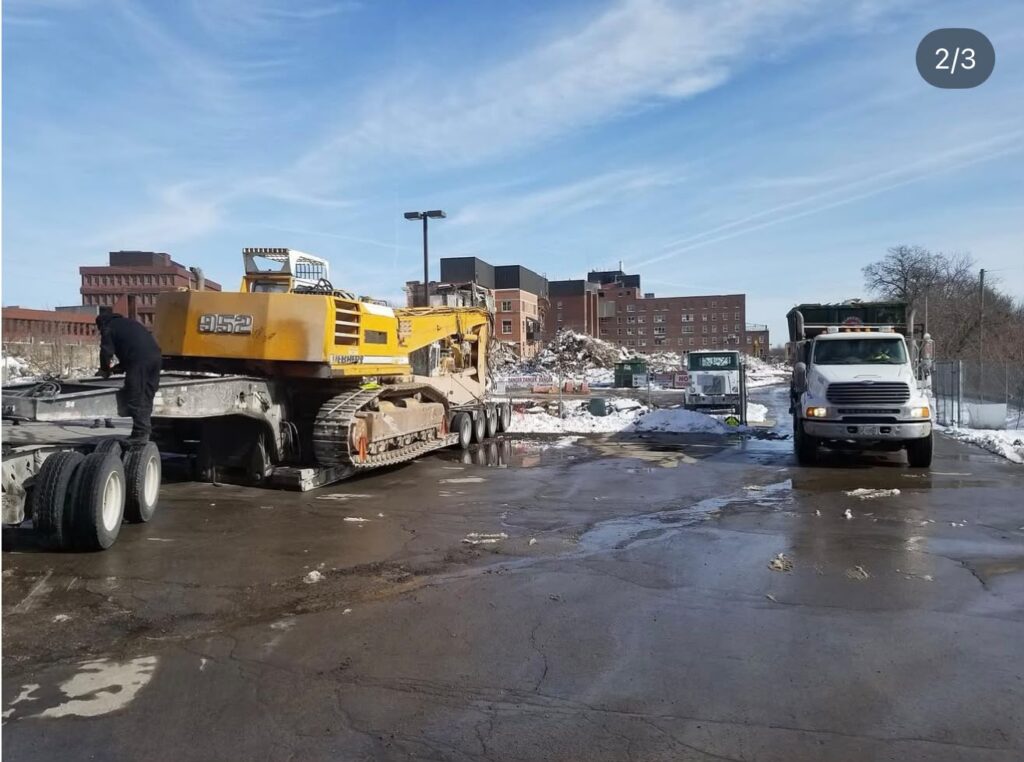
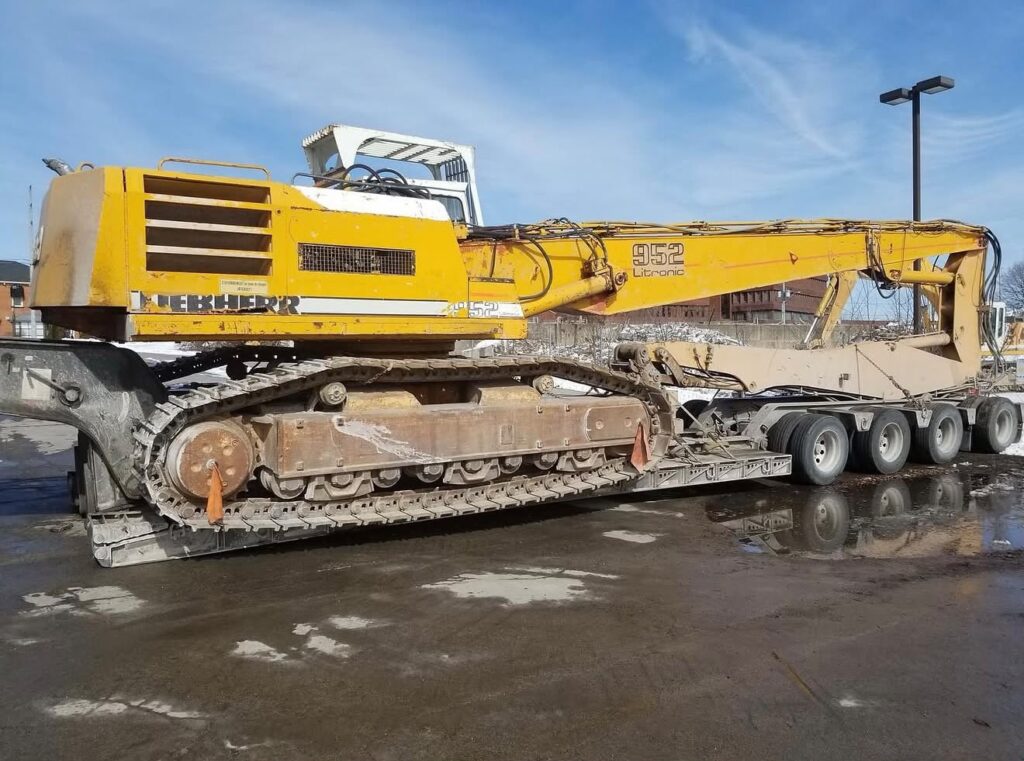
Project photographs show the Liebherr crawler excavator positioned on the multi-axle RGN lowboy trailer.
The machine’s steel tracks rested on the trailer deck, while heavy-duty chains were visible securing the equipment.
For large tracked machinery, positioning is important because the equipment’s weight must be supported and distributed appropriately across the trailer.
The excavator’s undercarriage, boom assembly, and available securement points also influence the transportation arrangement.
Heavy-duty chains and binders are used to restrain machinery during transportation, helping prevent movement during braking, acceleration, and turning.
The photographs document the excavator in its transportation configuration and show the specialized equipment used for this heavy equipment hauling project.
How Did the Long-Distance Route Affect the Transportation Plan?
The proposed relocation from Toronto to Calgary would involve approximately 3,400 km of interprovincial transportation.
For a shipment involving a large crawler excavator, the distance is only one part of the transportation challenge.
Heavy equipment hauling across multiple provinces may require consideration of different transportation restrictions and permit requirements.
The loaded trailer’s height, width, length, gross weight, and axle weights can influence which roads are suitable for the shipment.
Key Considerations for Long-Distance Heavy Equipment Transport
✓
Provincial oversize and overweight regulations
✓
Bridge capacity and axle-weight restrictions
✓
Available routes for specialized heavy-haul vehicles
✓
Overhead clearances
✓
Seasonal road restrictions
✓
Potential permit and escort requirements
✓
Loading and delivery site access
The RGN lowboy’s low deck height and multi-axle configuration helped address two important physical transportation requirements: overall loaded height and heavy-load support.
The actual route restrictions and permits would depend on the confirmed machinery specifications, loaded trailer dimensions, and approved route.
What Did Just Ship It Logistics Coordinate for the Customer?
The customer’s requirement was to relocate a large construction excavator using transportation equipment suitable for its size and configuration.
Just Ship It Logistics coordinated the specialized trailer arrangement rather than treating the machinery as standard freight.
The project involved matching the excavator with an appropriate multi-axle RGN lowboy configuration, considering how the equipment would be positioned, and arranging a transportation setup incorporating heavy-duty cargo securement.
The company’s role focused on bringing together the transportation resources required for moving large tracked construction machinery.
For the customer, this provided access to a specialized equipment hauling solution without needing to source the heavy-haul trailer independently.
The project demonstrates the value of coordinating trailer selection and machinery transportation requirements as connected parts of the same assignment.
Just Ship It Logistics arranged specialized heavy-haul transportation for the Liebherr 952 crawler excavator.
The machinery was positioned on a multi-axle RGN lowboy trailer with heavy-duty chain securement visible in the project photographs.
The selected equipment provided a transportation configuration appropriate for the excavator’s tracked undercarriage, substantial weight, and overall dimensions.
For the customer, the arrangement addressed the need for specialized machinery transport beyond the capabilities of conventional freight trailers.
This project highlights Just Ship It Logistics’ ability to coordinate heavy equipment hauling solutions for large construction machinery.
It also demonstrates how appropriate trailer selection helps address the logistical challenges associated with transporting valuable industrial equipment.
What Can Construction Companies Learn From This Heavy Equipment Transport Project?
The Liebherr excavator relocation illustrates why heavy machinery transportation should be planned around the equipment’s specific requirements.
Construction companies frequently need to relocate excavators, bulldozers, loaders, and other machinery between project sites.
However, different equipment types require different transportation solutions.
A smaller construction machine may be suitable for a conventional flatbed or step deck trailer. Larger tracked excavators may require an RGN lowboy or another specialized heavy-haul configuration.
Before arranging excavator shipping, equipment owners should establish accurate machinery dimensions and weight, determine loading and unloading requirements, and identify any route restrictions.
The selected trailer must also provide suitable support and securement for the machine.
For long-distance equipment hauling, these considerations become particularly important because the shipment may pass through multiple jurisdictions.
The Liebherr project demonstrates how specialized transportation coordination can help construction businesses identify appropriate hauling solutions for machinery that standard freight equipment cannot accommodate.
Excavator Transport FAQs: Liebherr 952 From Toronto to Calgary
RGN stands for Removable Gooseneck. The front of the trailer detaches, and the deck lowers to the ground so heavy equipment can be driven on from the front. That makes RGN trailers a common choice for tracked machines like excavators and bulldozers. For the Liebherr 952 crawler excavator, Just Ship It Logistics arranged a multi-axle RGN lowboy because it offered ground-level loading for the tracked undercarriage, a low deck to reduce overall height, and enough axles to support the machine’s weight.
A lowboy is any trailer with a deck that sits very low to the ground, used for tall and heavy equipment. An RGN is a type of lowboy with a gooseneck that detaches, so machines can drive on from the front. Fixed-gooseneck lowboys usually load from the rear with ramps. The Liebherr 952 excavator relocation used a multi-axle RGN lowboy, combining the low deck height of a lowboy with front loading access.
A step deck works for equipment that is moderately tall but can be loaded with ramps or a forklift and stays within legal height on its lower deck. An RGN is used when the machine is heavier, taller, or needs to be driven on at ground level. As the Liebherr project shows, smaller construction machines may fit on a flatbed or step deck, while large tracked excavators like the Liebherr 952 generally need an RGN or another heavy-haul configuration.
On an RGN, the gooseneck is detached and the front of the deck is lowered to the ground. The excavator is then driven onto the deck under its own power, positioned so its weight is spread correctly across the trailer axles, and the boom and bucket are lowered for transport. With the Liebherr 952, ground-level loading suited the tracked undercarriage and reduced the need for loading docks or ramps at the job site.
Excavators are secured with heavy-duty chains and binders attached to the machine’s tie-down points, restraining it during braking, acceleration and turning. The number and rating of chains depend on the machine’s weight. Project photographs of the Liebherr 952 show the excavator’s steel tracks resting on the RGN deck with heavy-duty chain securement in place.
Excavator weights range from a few tonnes for mini excavators to well over 40 tonnes for large crawler models. Weight decides the trailer type, the number of axles needed to spread the load, which roads and bridges can be used, and whether an overweight permit is required. For the Liebherr 952, its substantial operating weight was one of the main reasons a multi-axle RGN lowboy was chosen instead of a standard flatbed.
In Canada, each province issues its own permits for oversize or overweight loads, so an interprovincial move may need a permit in every province on the route. Depending on the load’s dimensions, a province may also require pilot cars (escort vehicles) and limit travel to certain hours. A Toronto to Calgary route can cross Ontario, Manitoba, Saskatchewan and Alberta, which is why the Liebherr project planning considered provincial regulations, axle weights and possible escort requirements.
During the spring thaw, many provinces reduce the weight allowed on certain roads to protect them while the ground is soft. Ontario calls this the reduced load or “half-load” period, and Alberta uses road bans. For heavy machinery, these limits can change the route or the timing of a move. Seasonal restrictions were one of the key planning factors listed for the 3,400 km Liebherr excavator relocation.
The Toronto to Calgary route is about 3,400 km. A heavy-haul load usually takes longer than standard freight over the same distance, because permits can limit travel to daylight hours, restrict weekend or holiday movement, and require specific routes. Weather, seasonal road restrictions and loading time at both job sites also affect the schedule.
The main cost factors are distance, the machine’s weight and dimensions, the trailer type and number of axles, permits in each province or state, pilot car requirements, route restrictions, and loading or unloading conditions at each site. A long interprovincial move like the Liebherr 952 relocation from Toronto to Calgary involves most of these factors at once.
Have the machine’s exact make and model, operating weight, and transport dimensions (length, width and height with the boom lowered), plus pickup and delivery addresses, site access details, and target dates. Note any attachments being shipped separately. As the Liebherr project shows, accurate weight and dimensions come first, because they decide the trailer, the permits and the route.