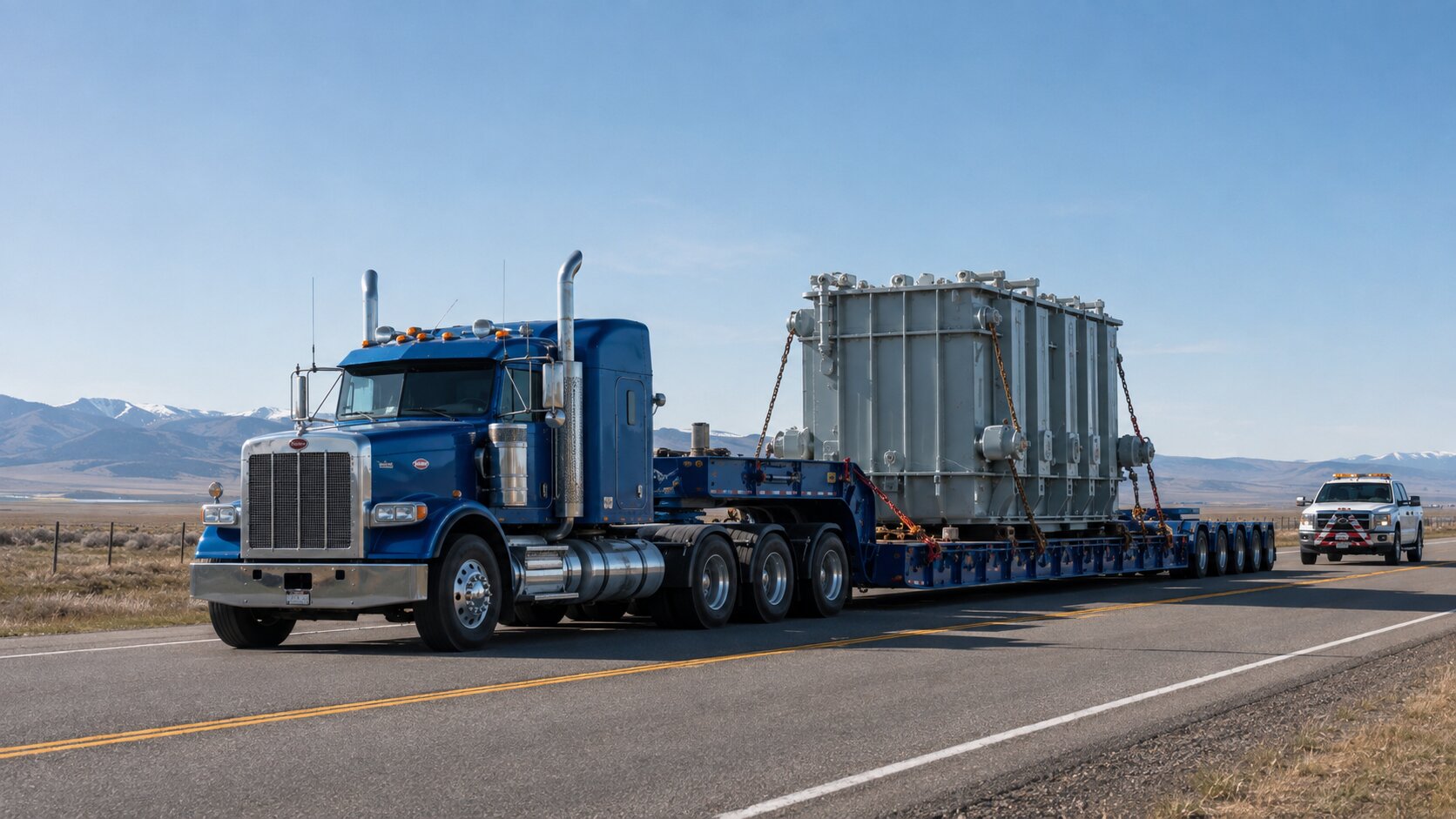
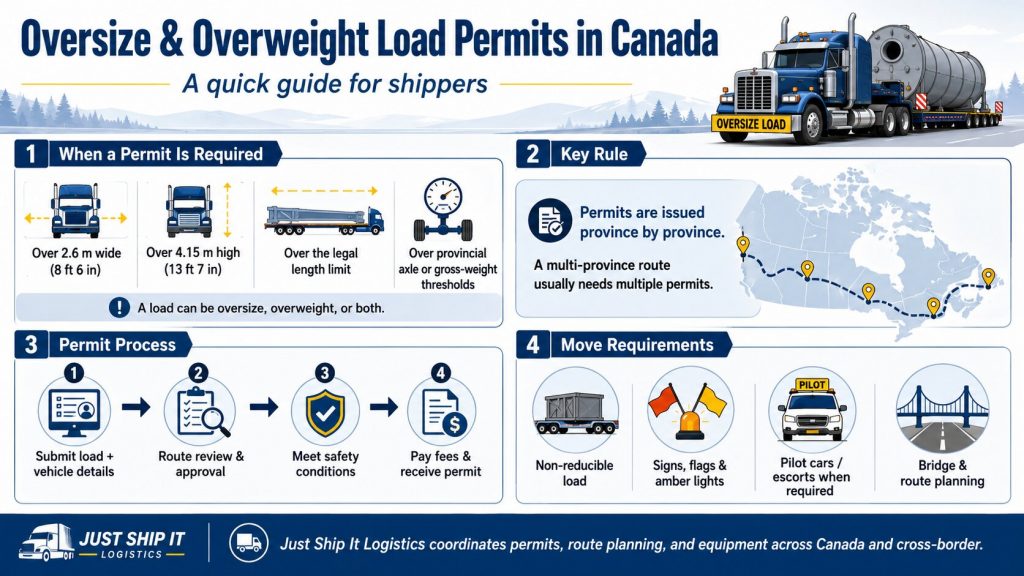
A load needs a permit in Canada the moment it passes the legal limit in any one dimension wider than 2.6 m (8 ft 6 in), taller than 4.15 m (13 ft 7 in), over the length limit, or heavier than the province’s axle and gross-weight thresholds. Cross any of those and the load is legally oversize (a dimension is over) or overweight (the weight is over), and it can’t move on public roads without an oversize/overweight permit. The catch that trips up most shippers: those base limits are the same across Canada, but the permit itself is issued province by province so a load crossing provincial lines often needs more than one.
Ready to move a specific load? Just Ship It Logistics matches your freight to the right equipment and handles the permits, routing, and escorts across Canada and cross-border.
Request a freight quote with your load’s dimensions and weight to get started.
An oversize load is any load that exceeds the standard legal limit in one or more dimensions — width, height, length, or overhang. Once a load is over the legal size in any direction, it can’t travel on public roads without an oversize permit from the province it’s moving through.
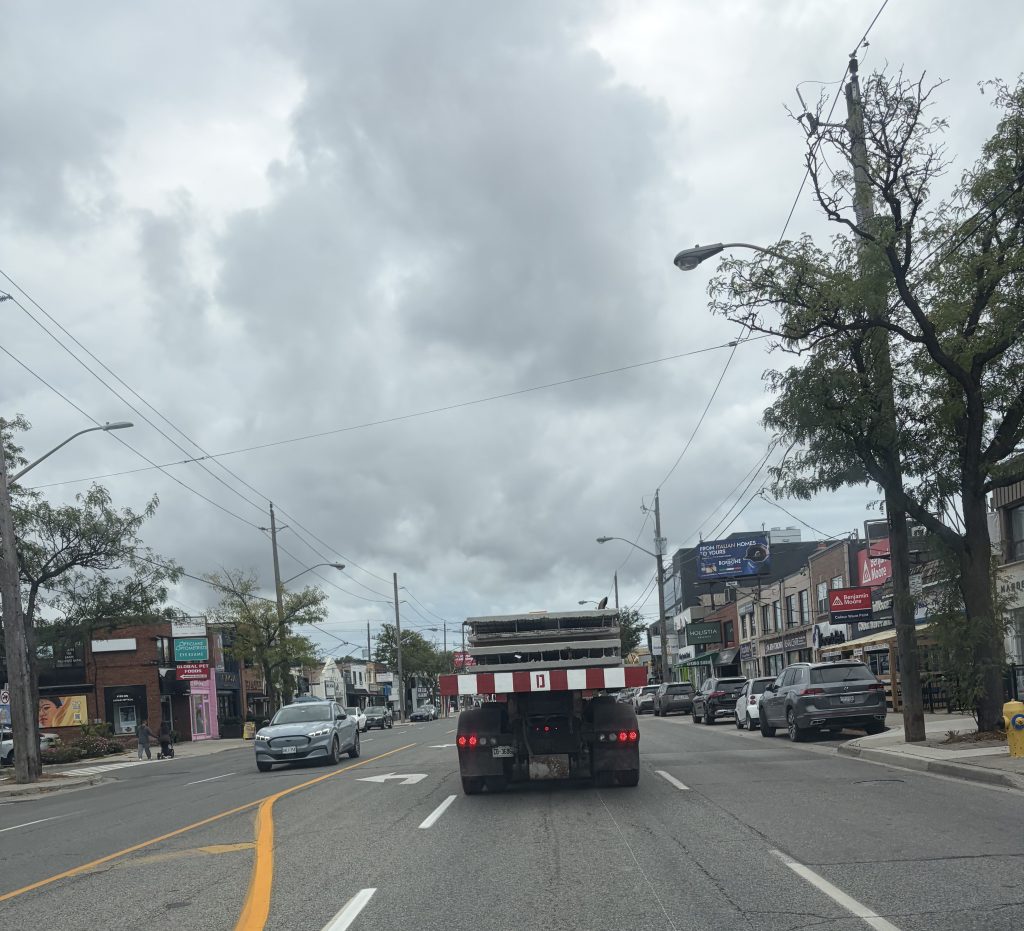
An overweight load exceeds the legal axle or gross-weight limits, regardless of its dimensions. A load can be perfectly legal in size but still overweight and it will need an overweight permit. Weight limits are set by axle configuration and spacing, not a single number, which is why two loads of the same total weight can have different legal standing.
The terms overlap but aren’t identical. A wide load is specifically over the width limit. An oversize load is over the legal limit in any dimension width, height, length, or weight. Put simply: all wide loads are oversize, but not all oversize loads are wide. A load can be over-height or overweight without being wide at all.
The freight that routinely moves oversize includes construction and industrial equipment excavators, bulldozers, cranes plus wind turbine blades and tower sections, modular and prefabricated homes, precast concrete panels, and bridge beams. What they share is that they can’t be broken down into smaller legal loads without losing their function.
Key takeaways
A load becomes oversize the moment it passes any of Canada’s standard legal limits. These limits are harmonized nationally through the Federal-Provincial-Territorial Memorandum of Understanding on Interprovincial Weights and Dimensions, so the base figures are consistent from province to province.
The maximum legal width for a vehicle and its load is 2.6 m (8 ft 6 in, or 102 in). This is the most common trigger for an oversize permit, because a load only has to be a few centimetres over to cross the line. Anything wider than 2.6 m needs an oversize permit in every province.
The maximum legal height, vehicle plus load, is 4.15 m (13 ft 7 in). (Note this is the Canadian figure the United States commonly uses 13 ft 6 in, which matters on cross-border moves.) Unlike width, height can sometimes be brought back under the limit by choosing a lower-deck trailer, which is often cheaper than permitting an over-height move.
Length limits depend on configuration: a single vehicle is generally capped at 12.5 m, and a tractor-semitrailer combination at 23 m. Loads that project past the back of the trailer (rear overhang) must be flagged, and past a certain point they trigger permit and escort requirements. Exact overhang thresholds are set provincially, so confirm them for the route.
Key takeaways
If a load exceeds any legal limit and can’t reasonably be reduced, you need a permit before it moves. Here’s how eligibility and the application work.
Permits are generally issued only for non-reducible (also called indivisible) loads a single piece that genuinely can’t be broken down to legal size without destroying its purpose, like an excavator or a turbine blade. If a load could be split into two legal shipments, provinces expect you to do that rather than permit an oversize move. This is the first question to settle: confirm the load is non-reducible before planning a permit, because a reducible load usually won’t qualify.
The application follows the same basic sequence in every province:
Apply with lead time. Larger or more complex moves need extra processing, and the busiest permit offices ask for several business days on non-standard loads.
A single-trip permit covers one move along a specified route within a set time window, the default for a one-off oversize shipment. An annual (or term) permit lets a specific vehicle and load configuration make repeated moves within set dimension and weight limits over a longer period, which suits carriers running the same oversize configuration regularly.
Overweight permits are assessed on axle configuration and spacing, not just gross weight spreading a load across more axles distributes the weight and can keep a heavy load legal, or reduce the permit level needed. This is why axle spacing is a required field on the application.
Key takeaways
The legal limits are national, but the permit is provincial; each province runs its own authority, application system, fees, and escort thresholds. A load crossing provincial lines needs a permit from each province it travels through. The table below links each province’s official permit authority.
| Province | Base legal limit (no permit) | Permit issued by |
|---|---|---|
| Ontario | 4.15 m H / 2.6 m W | Ontario MTO |
| Quebec | 4.15 m H / 2.6 m W | Transports Québec / SAAQ |
| Manitoba | 4.15 m H / 2.6 m W | Manitoba Transportation |
| Saskatchewan | 4.15 m H / 2.6 m W | SGI |
| Alberta | 4.15 m H / 2.6 m W | Alberta TRAVIS |
| British Columbia | 4.15 m H / 2.6 m W | BC CVSE |
| New Brunswick | 4.15 m H / 2.6 m W | NB Dept. of Transportation |
| Prince Edward Island | 4.15 m H / 2.6 m W | PEI Transportation & Infrastructure |
*Base height and width limits are harmonized nationally under the Federal-Provincial-Territorial MOU. Permit envelopes, fees, and escort thresholds vary by province always confirm with the issuing authority before the move.
Ontario permits are issued by the Ministry of Transportation (MTO). A permit is required whenever a vehicle or load exceeds the limits in the Highway Traffic Act, and applications should be filed several business days ahead of the move for exceptional dimensions.
Quebec permits are handled by Transports Québec / the SAAQ under the province’s Vehicle Load and Size Limits Regulation. A load exceeding the standard axle load, total mass, or dimensions requires a special permit before it can travel.
British Columbia permits run through Commercial Vehicle Safety and Enforcement (CVSE) and the onRouteBC system, with the rules in the Commercial Transport Procedures Manual. BC’s manual is updated regularly, so it’s a reliable current reference for thresholds and conditions.
Alberta permits are issued through TRAVIS (the Transportation Routing and Vehicle Information System), which can also cover participating municipal roads in one application useful when a load moves through cities as well as on provincial highways.
Saskatchewan permits are administered by SGI. A permit is required once a vehicle or load exceeds the province’s standard height, width, length, or weight limits, and is generally restricted to non-divisible loads.
Key takeaways
Oversize loads have to be marked so other drivers can see them coming. The specific dimensions (banner lettering, flag size) are set provincially, but the elements are consistent across Canada.
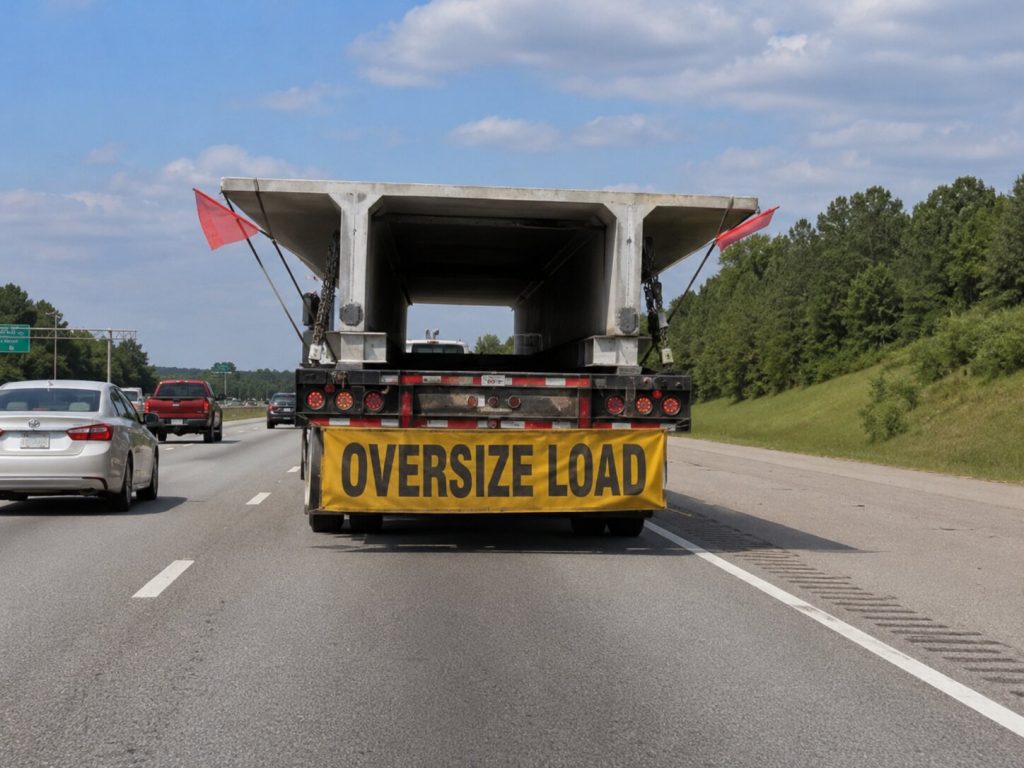
An OVERSIZE LOAD or “D” banner black lettering on a yellow background is displayed on the front and rear of the vehicle carrying an oversize load. At night or in low visibility the banner must be lit or reflective.
Bright red or orange warning flags mark the extremities and any projections of the load. For night or low-visibility travel, amber warning lights including a 360° roof light on the towing vehicle mark the load’s edges. Exact flag sizes and light specifications are set by each province.
Key takeaways
Above certain size thresholds, warning markings aren’t enough; the move needs pilot cars, and the route itself has to be planned around what the roads and bridges can take.
Pilot cars (escort vehicles) are required once a load passes width or height thresholds that vary by province. In British Columbia, for example, an overwidth load up to 3.2 m needs no pilot car, while a load from 3.2 m to 3.8 m requires one with more possible depending on the route. Other provinces set their own thresholds, so the escort requirement is confirmed at the permit stage.
A pilot car travels ahead of or behind the load to warn oncoming traffic, watch for clearance problems, and help the load through tight spots. A height-specific escort (sometimes called a pole car) carries a pole set to the load’s height to check overhead clearances, bridges, wires, signs — before the load reaches them.
Route planning isn’t only about width and height. Bridges and pavement have weight ratings, and a heavy load has to be routed over structures that can carry it. Provinces review the proposed route against bridge capacities as part of permit approval, and failing to plan for a weight-rated bridge is one of the most common causes of delay, rerouting, and fines on an oversize move.
Key takeaways
A superload is the largest tier of oversize/overweight moving load so large or heavy that it exceeds the limits of a standard permit and needs special engineering review and approval. Thresholds vary, but exceptional dimensions or weights (for example, loads well beyond normal permit width, length, or gross-weight caps) are routed to a province’s head permit office for a more involved approval that can include route engineering, bridge analysis, and multiple escorts. Superloads need the most lead time of any move.
An oversize load crossing into the United States has to satisfy both sides of the border. Canadian permits cover the Canadian leg; each US state the load travels through issues its own oversize/overweight permit, and US limits differ, height is state-controlled and commonly 13 ft 6 in rather than Canada’s 13 ft 7 in. Customs clearance runs alongside the permitting. Coordinating the Canadian permits, the US state permits, and customs is exactly the kind of hand-off that goes wrong when it’s split across parties. See our guide to cross-border freight shipping between Canada and the USA for how JSI manages the border side.
Every oversize move follows the same logic. A load is oversize or overweight the moment it passes 2.6 m wide, 4.15 m high, the length limit, or the provincial weight thresholds. From there it’s a sequence: confirm the load is genuinely non-reducible, identify which province’s authority issues the permit (and how many provinces the route crosses), meet the signage, escort, and route conditions, and file with enough lead time. Because the legal limits are national but the permit is provincial, a load moving across the country can need several permits stacked together each with its own escort rules and travel restrictions. Getting that sequence right is what keeps an oversize load legal from origin to destination, and it’s the coordination Just Ship It Logistics manages end to end across Canada and cross-border.
Ontario's maximum legal width for a vehicle and its load is 2.6 m (8 ft 6 in), set under the Highway Traffic Act. A load wider than 2.6 m requires an oversize/overweight permit from the Ontario Ministry of Transportation before it can travel on provincial roads.
A standard semi truck and trailer in Canada is built to the 2.6 m (8 ft 6 in) legal width limit. That's the maximum a trailer and its load can be without an oversize permit, so most dry vans and flatbeds are sized right up to it. Loads that overhang past that width become wide loads.
A wide load is a load that exceeds the legal width limit 2.6 m (8 ft 6 in) in Canada. It's a specific type of oversize load: over on width. Wide loads require an oversize permit, warning signage and flags, and, above certain widths, pilot cars to escort the move.
Yes. Any load exceeding the legal limits 2.6 m wide, 4.15 m high (13 ft 7 in), the length limit, or provincial weight thresholds needs an oversize or overweight permit, and permits are issued separately by each province the load travels through. Permits are generally granted only for non-reducible loads.
Yes. During spring thaw, many provinces impose seasonal weight restrictions (spring road bans) that lower the allowable axle weights on affected roads to protect them while they're soft. These bans can reduce or suspend overweight permits for a period each spring, so check for active restrictions on your route before planning a heavy move.
A superload is the largest category of oversize/overweight move, one that exceeds the limits of a standard permit and requires special engineering review and approval. Superloads typically need route engineering, bridge analysis, multiple escorts, and the most lead time of any oversize move.