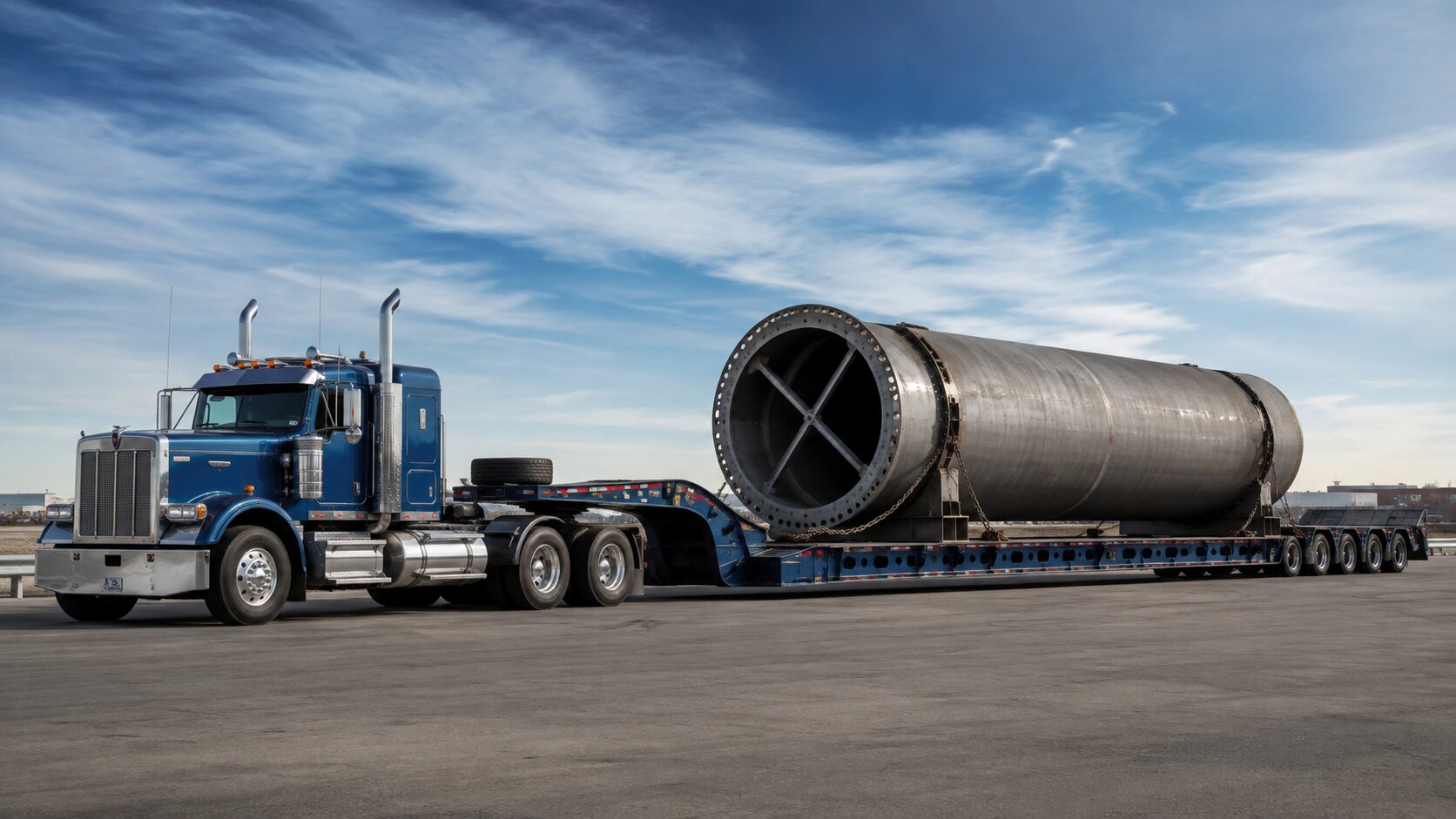
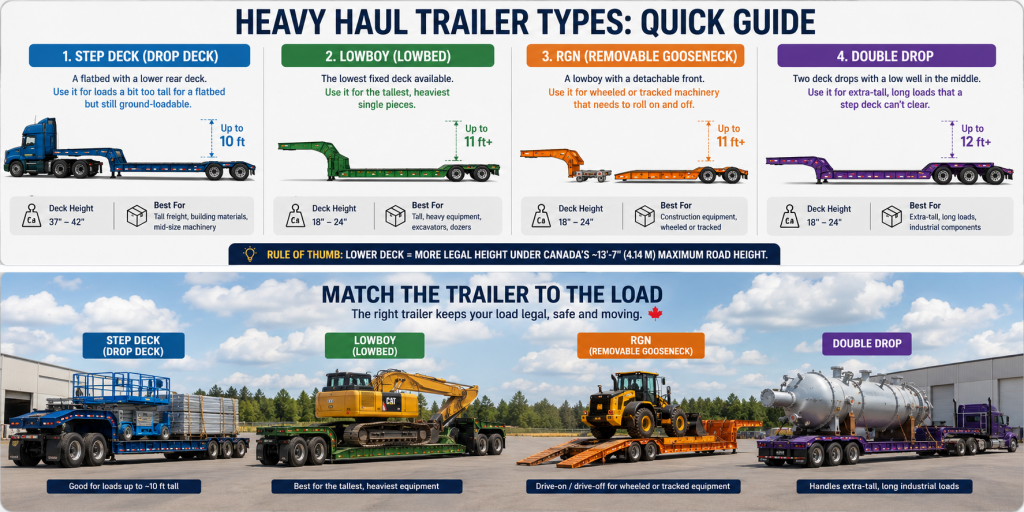
The right heavy haul trailer is decided by one thing before anything else: how tall your load sits once it’s on the deck. A flatbed gives you about 8 feet 6 inches of cargo height before you hit Canada’s legal limit. Drop the deck lower and you buy back height for taller machinery. Here’s the short version of the four trailers this guide covers:
Just Ship It Logistics arranges all four across Canada and cross-border through its carrier network, matching the load to the correct trailer so it moves legally the first time.
Heavy haul trailers are open-deck trailers built to move freight that is too tall, too long, too wide or too heavy for a standard dry van or flatbed. The category includes step decks, lowboys, RGNs and double drops. What separates them is deck height and how the deck is loaded and those two factors decide whether a load ships legally on a single permit or turns into a multi-permit, pilot-car project.
This guide is written for shippers moving construction equipment, industrial machinery and oversized freight who need to know which trailer their load belongs to before they request a quote. Get the trailer wrong and the load either can’t be loaded or exceeds legal height on the road. Get it right and the shipment clears the first time.
Every trailer below is compared against the flatbed baseline, because the flatbed is the reference point the whole category is measured from. A standard flatbed deck sits around 5 feet off the ground, which leaves roughly 8 feet 6 inches of usable cargo height under Canada’s legal maximum. When a load is taller than that, you move down the list to a lower deck.
Key takeaways
A step deck trailer, also called a drop deck, is a flatbed with two deck levels: a short upper deck over the axles and a longer lower deck behind them. The “step” down to the lower deck is what gives it extra cargo height. It is the same trailer whether someone calls it a step deck, a stepdeck, a drop deck or a step deck truck.
Step decks handle freight that is slightly too tall for a flatbed but doesn’t need the extreme low profile of a lowboy. The lower deck also makes ground-level loading safer, and many step decks carry ramps so wheeled equipment can be driven up.
Typical step deck figures (verify against the specific carrier’s equipment before quoting):
Because the lower deck sits well below a flatbed’s, you gain roughly a foot and a half of legal cargo height without any permit which is why step decks are the default for freight in the 8-foot-6 to 10-foot range.
Step decks suit palletized freight stacked tall, building materials, mid-size machinery, and equipment that can be forklifted or driven onto the lower deck. If a load rolls on its own wheels and stands under about 10 feet, a step deck usually handles it without triggering an oversize permit.
Key takeaways
A lowboy trailer also called a lowbed or low bed trailer has the lowest deck of any open-deck trailer, sitting in a “well” between the gooseneck and the rear axles. That low deck is what lets a lowboy carry the tallest, heaviest single pieces of equipment while staying under legal height.
The trade-off is deck length. Because the low well sits between the axles, the loadable section is shorter than a step deck’s, so lowboys favour tall, compact, heavy loads over long ones.
Typical lowboy figures:
The low deck is the whole point. Dropping the deck to under 2 feet buys back the height that heavy equipment eats up, so tall machinery ships legally that would never clear on a flatbed.
Lowboys come in two loading styles. A fixed-neck lowboy has a permanently attached front, so equipment must be craned or winched over the side or rear. A detachable-neck lowboy the RGN, covered next has a front that removes to create a drive-on ramp. If your equipment can roll, the detachable neck saves the cost and time of a crane.
Lowboys move excavators, bulldozers, cranes, large industrial machinery and other tall, heavy single units. Anything that combines serious weight with height that a step deck can’t clear belongs on a lowboy or its RGN variant.
Key takeaways
An RGN, or removable gooseneck trailer, is a lowboy whose front gooseneck detaches and lowers to the ground to form a ramp. That’s the key relationship to remember: an RGN is a type of lowboy; the difference is the drive-on front. Once the gooseneck is off, wheeled and tracked equipment can be driven straight onto the low deck, then the gooseneck reattaches for transport.
RGNs give you the low deck height of a lowboy plus the easiest loading method for anything that moves under its own power. That combination makes them a workhorse for self-propelled construction equipment.
This front-load method avoids cranes for anything drivable, which is often faster and cheaper than side or rear loading.
RGN specs mirror lowboys: a well deck around 18 – 24 inches high, a well length of roughly 24 – 29 feet, and base payloads near 40,000 lbs that climb well past 80,000 lbs as axles are added for heavier loads. As with any heavy haul equipment, confirm the exact deck height, well length and axle configuration with the carrier before the load is booked.
Key takeaways
A double drop trailer also called a double drop deck has two deck drops: one behind the gooseneck and one before the rear axles, leaving a low well in the middle. That well sits lower than a step deck’s lower deck, so a double drop carries taller freight than a step deck while offering more deck length than a lowboy well.
Think of it as the middle ground for tall and long loads: not quite as low as a lowboy, but with a longer usable low section.
Typical double drop figures:
The low well is what earns the double drop its place: it clears extra-tall freight while keeping a longer flat run than a lowboy offers.
Choose a double drop when a load is too tall for a step deck’s lower deck but longer than a lowboy well can hold. It splits the difference more height than a step deck, more length than a lowboy which suits long, tall machinery and oversized fabricated sections.
Key takeaways
| Factor | Flatbed | Step Deck (Drop Deck) | Lowboy (Lowbed) | RGN | Double Drop |
|---|---|---|---|---|---|
| Deck height | 5 ft (1.5 m) | Lower deck 37 – 42 in (94 – 107 cm) | Well 18 – 24 in (46 – 61 cm) | Well 18 – 24 in (46 – 61 cm) | Well 18 – 24 in (46 – 61 cm) |
| Max cargo height (typical) | 8 ft 6 in (2.6 m) | 10 ft (3.05 m) | 11 ft 6 in – 12 ft (3.5 – 3.66 m) | 11 ft 6 in 12 ft (3.5 – 3.66 m) | 11 ft 6 in (3.5 m) |
| Typical payload | 48,000 lbs (21,800 kg) | 40,000 – 48,000 lbs (18,100 – 21,800 kg) | 40,000+ lbs (18,100+ kg, more w/ axles) | 40,000+ lbs (18,100+ kg, more w/ axles) | 40,000 lbs (18,100 kg) |
| Loading | Top/side/rear | Ramps, forklift, drive-on | Crane or over-side | Drive-on (detach neck) | Crane, over-side |
| Best for | Standard legal-height freight | Freight slightly too tall for flatbed | Tallest, heaviest single pieces | Self-propelled equipment | Extra-tall and long loads |
*Figures are typical industry ranges and vary by manufacturer and axle setup. Confirm exact specs with the assigned carrier before booking.
Key takeaways
Work the decision in this order:
When height, length and weight combine in ways that break normal legal limits, the load becomes oversized or overweight which brings permits and, sometimes, escorts into play.
Key takeaways
A steel manufacturer contacted Just Ship It Logistics with an oversized shipment that needed to reach its destination within a tight delivery window. The steel could not simply be placed on a standard trailer and sent on its way. Its dimensions required careful trailer selection, load planning and route coordination before the shipment could leave. With very little room for delays, the team reviewed the freight specifications, matched the load with appropriate heavy-haul equipment and coordinated the shipment around the customer’s required delivery schedule.
As the shipment progressed, unexpected issues created additional pressure on an already demanding timeline. Instead of allowing those complications to delay the delivery, Just Ship It Logistics stayed in close contact with the carrier and the customer, adjusted the plan and worked through each issue as it appeared. The customer did not have to manage several carriers or chase different parties for updates. They had one team overseeing the shipment, communicating clearly and keeping the freight moving until the oversized steel was successfully delivered.
Despite the tight timeline and unexpected challenges, the shipment was completed successfully. This project showed that heavy-haul transportation is not only about finding an available trailer. It requires careful preparation, quick problem-solving and clear communication throughout the entire move. By managing each part of the process, Just Ship It Logistics helped the customer avoid unnecessary delays and delivered the oversized steel with confidence.
Choosing the right trailer keeps many loads legal, but not all. In Canada, a load is generally treated as oversized once it exceeds standard legal limits roughly 4.15 m (about 13 ft 7 in) high and 2.6 m (about 8 ft 6 in / 102 in) wide and overweight once axle or gross weights pass provincial thresholds. These limits are harmonized nationally but administered by each province, so a load crossing provincial lines may need more than one permit.
| Province | Max height (no permit) | Max width (no permit) | Permit authority |
| Ontario | 13 ft 7 in (4.15 m) | 8 ft 6 in / 102 in (2.6 m) | Ontario MTO |
| Quebec | 13 ft 7 in (4.15 m) | 8 ft 6 in / 102 in (2.6 m) | Transports Québec / SAAQ |
| Manitoba | 13 ft 7 in (4.15 m) | 8 ft 6 in / 102 in (2.6 m) | Manitoba Transportation |
| Saskatchewan | 13 ft 7 in (4.15 m) | 8 ft 6 in / 102 in (2.6 m) | SGI |
| Alberta | 13 ft 7 in (4.15 m) | 8 ft 6 in / 102 in (2.6 m) | Alberta TRAVIS |
| British Columbia | 13 ft 7 in (4.15 m) | 8 ft 6 in / 102 in (2.6 m) | BC CVSE |
*Height and width are harmonized nationally under the Federal-Provincial-Territorial MOU; anything above these limits requires a provincial oversize/overweight permit. Maximum length and weight are set by axle configuration and vary confirm per route.
Two things follow from that. First, permits are filed per jurisdiction, and the trailer choice can change whether a load needs one at all dropping to a lower deck can bring a tall load back under the height limit and avoid an oversize permit entirely. Second, loads that stay oversized even on the right trailer may require pilot cars (escort vehicles) and travel-time restrictions.
This is where the trailer decision and the paperwork meet. For the permit and escort side of oversized moves, see our guide to oversize and overweight load permits in Canada. Just Ship It Logistics coordinates the trailer, the routing and the permit filing together, so the equipment is matched to the load and the load stays legal across every province it crosses.
Key takeaways
Every heavy haul move comes back to the same starting question: how tall, long and heavy is the load, and how does it load? A flatbed covers standard legal-height freight; a step deck buys back height for loads up to about 10 feet (3.05 m); and a lowboy, RGN or double drop takes over when equipment is taller, heavier, or needs to roll on under its own power. Get that match right at the quoting stage and the shipment moves legally the first time, get it wrong and the load either can’t be loaded or exceeds legal height on the road.
The regulatory side follows the same logic. Canada’s height and width limits are consistent from province to province, but permits are administered separately by each one, and the right trailer choice can be the difference between a routine move and a multi-permit, pilot-car project. Pairing the correct trailer with the correct paperwork is what keeps oversized freight legal from origin to destination which is exactly the coordination Just Ship It Logistics manages across Canada and cross-border.
Choosing between a step deck, lowboy, RGN or double drop comes down to how tall, long and heavy your load is, and how it loads. Match those factors to the deck and the shipment moves legally the first time. When you’re ready to move a specific piece, Just Ship It Logistics arranges heavy haul freight across Canada and cross-border, matching your equipment to the right trailer and handling the permits and routing.
Request a freight quote with your load’s dimensions and weight to get started.
You can typically load a step deck trailer up to about 10 feet of cargo height on its lower deck while staying under Canada's roughly 13-foot-7-inch legal limit. Exact clearance depends on the trailer's lower-deck height, so confirm the specific figure with the carrier before loading a tall piece.
An RGN is a type of lowboy. Both have a low deck sitting in a well between the axles for maximum cargo height. The difference is that an RGN (removable gooseneck) has a detachable front that lowers into a ramp, letting equipment drive straight on, while a standard lowboy is loaded by crane or over the side.
A step deck has a single lower deck around 37 - 42 inches high, good for cargo up to about 10 feet. A double drop trailer has a lower well between two deck drops, sitting around 18 - 24 inches high, so it carries taller freight up to roughly 11 feet 6 inches while keeping a longer flat run than a lowboy.
A lowboy trailer's well deck typically sits about 18 - 24 inches off the ground, the lowest of any open-deck trailer. That low deck lets a lowboy carry cargo up to roughly 11 feet 6 inches to 12 feet tall while staying within legal height. Exact deck height varies by model and axle configuration.
A double drop trailer is used for freight that is both tall and long machinery, oversized fabricated sections and equipment that is too tall for a step deck but longer than a lowboy well can hold. Its low central well clears extra height while offering more usable deck length than a lowboy.
Yes. A load that exceeds standard legal limits roughly 4.15 m (about 13 ft 7 in) high or 2.6 m (about 8 ft 6 in) wide, or over provincial weight thresholds needs an oversize or overweight permit, filed per province. Some loads also require pilot cars. Choosing a lower-deck trailer can bring a tall load back under the height limit and avoid a permit.