
Most less-than-truckload (LTL) shipments between major Canadian cities arrive in about 1 to 7 business days. At Just Ship It Logistics, we typically see Toronto to Montreal deliver in 1 to 3 business days, Vancouver to Toronto in 3 to 5 days, and Halifax to Toronto in 4 to 7 days. Days are counted from the business day after pickup. Pickup days, weekends and holidays don’t count toward transit time.
Here’s the part many shippers don’t hear up front: a standard LTL transit time is an estimate, not a promise. As the Georgia Tech LTL training guide explains, standard service is the carrier’s advertised transit time, and it isn’t guaranteed. Your pallets share a trailer with other shippers’ freight, pass through one or more terminals, and depend on a network that’s bigger than most people realize. Canada had approximately 152,000 trucking businesses as of December 2024, according to Transport Canada’s Transportation in Canada 2024 report. Transport Canada also notes that the country’s vast, rugged terrain and four-season climate make variability a longstanding reality for transportation and logistics. And for cross-border shippers, trucks carried 55.5% of all U.S. – Canada freight by value in 2024, per the U.S. Bureau of Transportation Statistics.
Below, we break down typical transit times by lane, the most common reasons LTL freight runs late, and how to plan around them.
Domestic LTL shipments in Canada usually take 1 to 7 business days between major cities. Shorter regional lanes sit at the low end of that range, cross-country lanes sit at the high end, and rural or remote delivery points can add more time. Carriers often add service days for rural areas, so a pallet going to a small town outside Thunder Bay will usually take longer than one going to downtown Winnipeg.
The reason LTL takes longer than a dedicated truck is simple: your freight isn’t travelling alone.
A typical LTL shipment moves like this:
Along the way, LTL freight gets loaded and unloaded several times, and most LTL carriers run on a fixed schedule. If your freight misses one departure, it waits for the next one.
Transit times are counted in business days, Monday to Friday. The day of pickup doesn’t count, and weekends and holidays aren’t counted as transit days. The clock also starts on the date your freight actually gets picked up, not the date the pickup was scheduled for.
Here’s how that plays out. Say a manufacturer in Mississauga ships three pallets to Calgary on a Friday afternoon, and the quoted transit time is 4 business days. Day 1 is Monday, so the expected delivery is Thursday. If that Monday is a statutory holiday, delivery moves to Friday. Keep in mind that statutory holidays differ by province, so a holiday at either end of the lane can shift your date.
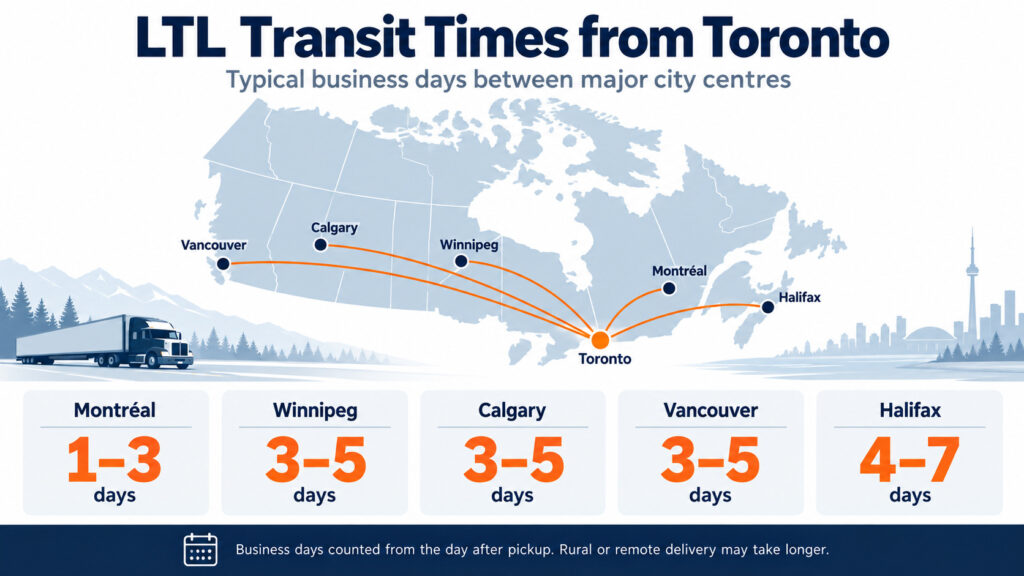
Most Canadian LTL freight moves through Central Canada. Transport Canada identifies the Quebec City – Windsor Corridor as the country’s busiest trucking corridor, and Ontario is home to nearly half of all Canadian trucking businesses (49.7% as of 2023, per Transportation in Canada 2023). Here’s what we typically see at Just Ship It Logistics on five major lanes out of Toronto:
| Lane | Typical LTL transit (business days) |
| Toronto and Montreal | 1 to 3 |
| Toronto and Winnipeg | 3 to 5 |
| Toronto and Calgary | 3 to 5 |
| Toronto and Vancouver | 3 to 5 |
| Toronto and Halifax | 4 to 7 |
*Business days from the day after pickup, between major city centres. Rural and remote points may add time.
Toronto to Montreal LTL transit time
Toronto to Montreal usually delivers in 1 to 3 business days. It’s one of the shortest and busiest LTL lanes in the country, running along Highway 401 inside the Quebec City – Windsor Corridor. Freight picked up early in the day can sometimes deliver the next business day. During Quebec’s construction holiday in the last two weeks of July, many receivers in the province close or run short-staffed, so deliveries can wait until someone is there to accept them.
Toronto to Winnipeg usually takes 3 to 5 business days. The trip crosses Northern Ontario on the Trans-Canada Highway, where winter storms and highway closures between Sault Ste. Marie and Kenora can add a day or more. In spring, Manitoba’s seasonal road restrictions limit truck weights on some provincial roads, which can slow deliveries to rural points outside Winnipeg.
Toronto to Calgary usually takes 3 to 5 business days. On long western lanes, some carriers move part of the trip by rail, which can affect timing. We cover that in the rail linehaul section below. In early July, the Calgary Stampede brings heavy traffic and road closures near downtown, which can push back delivery appointments in the city core.
Toronto to Vancouver usually takes 3 to 5 business days. This is a coast-to-coast lane, so winter conditions on mountain routes in British Columbia, like the Coquihalla Highway and Rogers Pass, can slow freight between November and March. Fall rain is a risk too: in November 2021, atmospheric river flooding closed the Coquihalla and other key highways into the Lower Mainland for weeks.
Toronto to Halifax usually takes 4 to 7 business days. Freight runs through Quebec and New Brunswick, and deliveries outside the Halifax area, such as smaller communities in Nova Scotia, often need extra time for final delivery. All road freight into Nova Scotia crosses the narrow Chignecto Isthmus near Amherst, so a winter storm or flooding on that one stretch of the Trans-Canada can hold up shipments across the whole province.
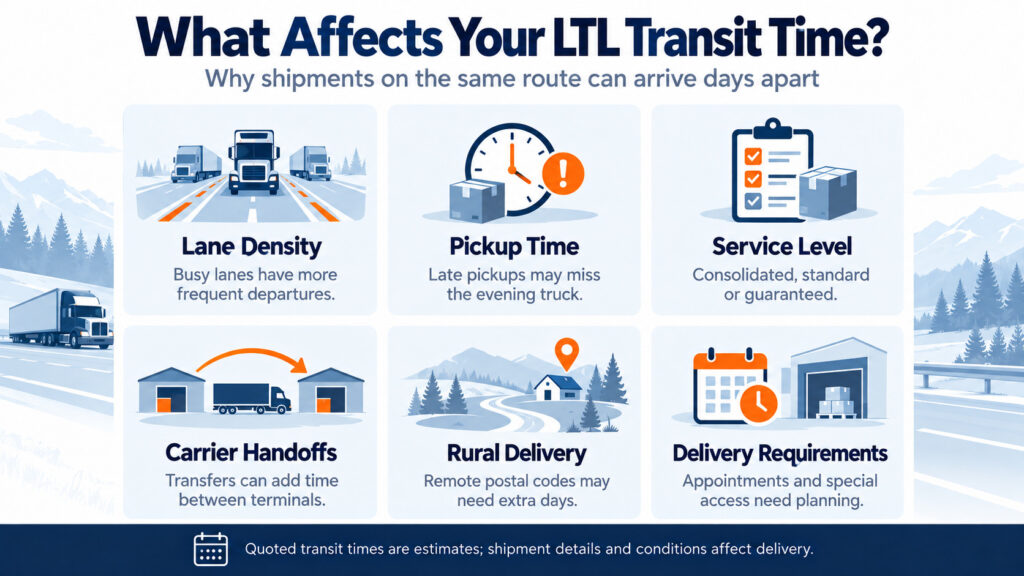
Two shipments on the same lane can arrive days apart.
The quoted transit time is a baseline, and these factors decide where your shipment lands within, or outside, that range:
Key takeaway: Most LTL shipments between major Canadian cities take 1 to 7 business days, counted from the day after pickup. Your lane, pickup time, service level and delivery location decide where your shipment lands in that range.
A standard LTL transit time is the carrier’s best estimate based on its normal schedule, not a delivery promise. As the Georgia Tech LTL training guide explains, standard service is the carrier’s advertised transit time, and it’s an estimate that isn’t guaranteed. The carrier’s rules tariff (the legal document that sets its terms, charges and service rules) is what defines what’s actually promised, and for standard service, a specific delivery date usually isn’t.
That’s not carriers being careless. An LTL network depends on dozens of shippers, terminals, drivers and receivers all doing their part on schedule. When one piece slips, the freight around it slips too. Add Canada’s geography and climate, and the variation makes sense: Transport Canada’s 2024 network performance report notes that the country’s vast, rugged terrain and four-season climate make variability a longstanding reality for transportation.
In practice, that means:
Standard LTL service is the default. It’s priced for value, uses the carrier’s regular network schedule, and gives you an estimated delivery date.
Guaranteed LTL service costs more, but it puts the carrier on the hook for the date. If the shipment misses the quoted transit time, you’ll get a full or partial refund of freight charges, depending on the carrier and whether eligibility rules are met. Guarantees usually come with a delivery window: guaranteed service typically means delivery by 5 p.m. on the scheduled day, with options for delivery by noon, 10 a.m. or even 8 a.m. on many carriers.
| Name | Standard LTL | Guaranteed LTL |
| Delivery date | Estimate | Committed |
| Cost | Lower | Higher (premium added) |
| If late | Usually no refund | Full or partial refund, if terms are met |
| Best for | Flexible deadlines, regular restocking | Store openings, trade shows, production line parts |
Before you pay for a guarantee, read the fine print. Common exclusions include interline shipments that involve a partner carrier, and the guarantee only applies once the freight has been picked up. Guarantees can also be suspended in unusual conditions: during COVID-19, some carriers stopped issuing refunds on late guaranteed freight. A broker can check the current rules tariff for you before you book.
And when the date can’t move at all, a guarantee may still not be enough. For freight that absolutely must arrive on a set day, a direct-drive (dedicated truck) service is often the better choice.
Key takeaway: A standard LTL transit time is the carrier’s best estimate, not a promise. If your delivery date can’t move, book guaranteed LTL or a dedicated truck, and check the guarantee’s terms first.
Why does it feel like every delivery is delayed?
If it feels like your freight is late more often than not, you’re not imagining it. Research cited in a 2026 study from the MIT Center for Transportation & Logistics found that LTL carriers average about 71% on-time performance, with shippers often seeing delays of up to three days past the published transit time. That means close to three in ten shipments miss the quoted date.
There’s also a simple reason late shipments stick in your mind: on-time freight is invisible.
Nobody calls the office to say the pallets arrived as planned. But a late delivery means a phone call from your customer, a scramble on the warehouse floor, and maybe a missed production run. A few of those in a row, and it feels like the whole system is broken.
The same MIT study found that delays aren’t random. Shipment details, accessorial services, delivery appointments and regional lane characteristics all had a significant effect on how likely a shipment was to run late, and by how much. In other words, a lot of delay comes from how the shipment is set up, not just from the road.
LTL runs on tight, connected schedules. A local driver may have 10 to 15 pickups and deliveries in a day, and the linehaul trailer leaving the terminal that night is waiting for all of them. So when one stop runs long, everything after it moves too.
Long waits at docks are common. A 2024 study by the American Transportation Research Institute (ATRI) found that U.S. drivers were detained (held more than two hours at a customer facility) at 39.3% of all stops, and that for-hire trucking lost 135.9 million hours to detention in 2023. Earlier ATRI research found that most drivers had run out of their legal driving hours while waiting at a customer facility.
Here’s how that plays out on a typical day in the Greater Toronto Area:
One two-hour wait at someone else’s dock can push back shipments for a dozen shippers who did everything right.
It’s a fair question: if delays are common, why not quote a longer transit time and hit it every time?
The short answer is competition. Shippers compare quotes on price and transit time, and carriers market their published transit standards as a selling point. FedEx Freight, for example, has long promoted that its Priority service has the fastest published transit times of any nationwide LTL service. A carrier that adds two buffer days to every quote would lose business to one that doesn’t, even if the slower quote was more honest.
Published transit times also reflect how the network runs when everything goes to plan. Most shipments do move on that schedule, so the carrier quotes it. The trouble is that a published transit time isn’t a reliable indicator of a carrier’s actual on-time performance, and shippers rarely get to see the real numbers.
That’s where a broker helps. At Just Ship It Logistics, we look at how carriers actually perform on your lane, not just what they publish, so the date you plan around is one you can count on.
Key takeaway: LTL delays are common because one late stop can push back freight across the whole network. Carriers quote their best-case schedule to stay competitive, so plan with that in mind.
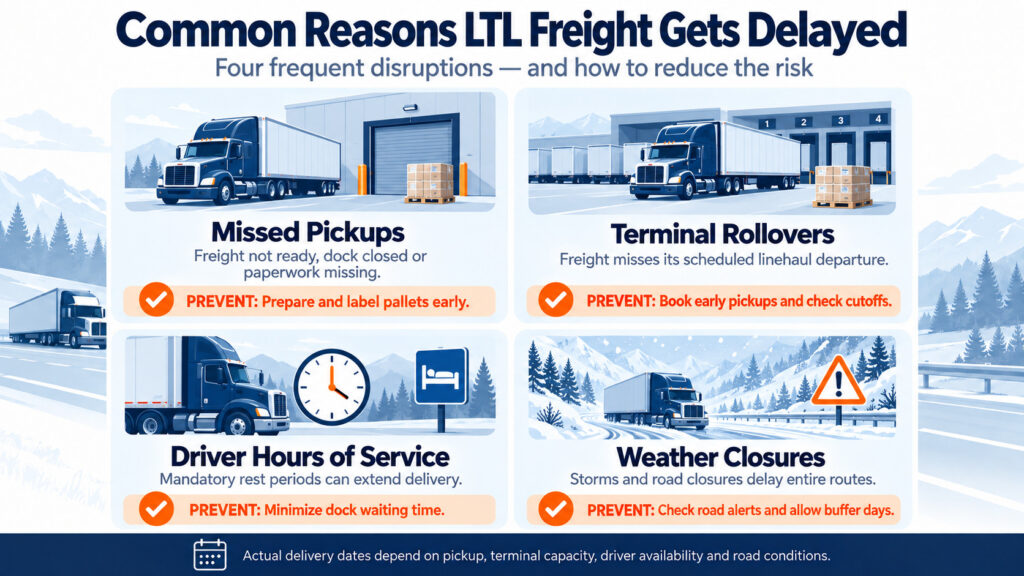
Most LTL delays come from a short list of causes. Some are out of anyone’s control, like a
blizzard closing the highway. Many others can be spotted, and often prevented, before the freight even leaves your dock. Here are the eight we see most often at Just Ship It Logistics.
A missed pickup is one of the most common delays, and it happens before your freight moves a single kilometre. The driver may arrive to find the freight isn’t wrapped or labelled, the dock already closed, or the paperwork missing. Sometimes the driver simply runs out of time on a long route and can’t get to your stop that day.
Because the transit clock starts on the date your freight is actually picked up, not the date the pickup was booked, a missed pickup pushes your whole delivery date back. A shipment booked Tuesday and picked up Wednesday will deliver at least a day later than planned.
How to avoid it: Have freight palletized, wrapped and labelled before the pickup window opens. Give your carrier or broker accurate dock hours, and let them know right away if the freight won’t be ready.
A terminal rollover happens when your freight reaches the origin terminal but doesn’t get loaded onto its scheduled linehaul trailer. Instead, it “rolls” to the next departure. On a busy lane, that might mean waiting until the next night. On a lane with only a few departures a week, it can mean several days.
Rollovers usually happen because the trailer is full, the freight arrived after the terminal’s cutoff, or the terminal is short on dock workers during a busy stretch. Since LTL freight is loaded and unloaded several times along the way, a rollover can happen at the destination terminal or a hub in between, too.
How to avoid it: Earlier pickups give your freight more time to make the night’s linehaul. On time-sensitive shipments, ask whether the lane has daily departures before you book.
Truck drivers in Canada and the U.S. can only drive and work a set number of hours before they must stop and rest. These limits keep drivers and everyone else on the road safe, and they’re tracked by electronic logging devices (ELDs), so there’s no stretching them.
In Canada, the Commercial Vehicle Drivers Hours of Service Regulations set a 13-hour daily driving limit and require eight consecutive hours off before a driver can drive again. Once freight crosses into the U.S., the Federal Motor Carrier Safety Administration’s hours-of-service rules apply, and those are stricter: drivers in the United States can drive for 11 hours within a 14-hour window.
That two-hour difference matters on cross-border lanes. A trip that one Canadian driver could finish in a day may need an extra rest break once the truck is south of the border. And when a driver loses hours waiting at a dock, as we covered in the domino effect section above, the end of the route rolls to the next day.
How to avoid it: You can’t change the rules, but you can protect the driver’s time. Fast loading and unloading at your dock keeps hours available for the road.
Canadian weather is one of the biggest wildcards in LTL transit. Winter storms, freezing rain and whiteouts close highways across the country every year, especially on long stretches with no easy detour, like the Trans-Canada through Northern Ontario or the mountain passes in British Columbia. Transport Canada notes that Canada’s four-season climate makes variability a longstanding reality for the transportation network.
Weather delays also spread beyond the closed road. When a highway reopens, carriers have a backlog of freight to move, terminals fill up, and rollovers become more likely for a few days after the storm has passed. Spring flooding and summer wildfires can do the same, as recent seasons in British Columbia and Alberta have shown.
How to avoid it: Check road conditions on Ontario 511, DriveBC or your province’s 511 service before a critical shipment, and add buffer days to winter shipments on long-haul lanes.
The bill of lading (BOL) is the instruction sheet for your shipment. It tells the carrier what’s on the pallet, how much it weighs, its dimensions, its freight class, and where it’s going. When any of those details are wrong, the freight can be held at the terminal until someone sorts it out.
The most common BOL problems we see are:
Wrong weight or dimensions. If the carrier’s scale or dimensioner doesn’t match the BOL, the shipment may be held for a reweigh or re-inspection.
Wrong freight class. LTL pricing in North America is based on the National Motor Freight Classification (NMFC), managed by the National Motor Freight Traffic Association (NMFTA). A pallet listed at the wrong class can be stopped, reclassified and rebilled. Our guide to freight class for Canadian shippers explains how to get it right.
Missing or unclear details. A missing postal code, contact name or phone number at the receiver means the carrier can’t book the delivery.
Each of these turns into a phone call, a correction, and often a missed linehaul. We cover reweighs and reclassifications in more detail below, because they’re one of the most unexpected delays shippers run into.
How to avoid it: Weigh and measure every pallet before booking, confirm the freight class, and double-check the delivery address and contact against the purchase order.
For freight moving between Canada and the U.S., customs clearance adds a step that domestic freight doesn’t have, and paperwork problems at the border are a common cause of delay. Trucks can be held at the crossing, or the freight can sit at a bonded terminal, until the customs broker resolves the issue.
For shipments coming into Canada, the biggest recent change is the CBSA Assessment and Revenue Management (CARM) system. Since May 20, 2025, all commercial importers have been required to post their own financial security (such as a surety bond) to use the Release Prior to Payment (RPP) program. A customs broker’s security no longer covers its importers. Importers without their own security can’t get the usual electronic release. Instead, they need to request a manual, paper release at the local CBSA office and pay duties and taxes directly before the goods are released, which can add hours or days.
Other common cross-border holdups include:
How to avoid it: Make sure your business is registered on the CARM Client Portal and has its own RPP security in place. Send complete commercial invoices and origin documents to your customs broker before pickup, not when the truck is at the border.
Accessorials are extra services beyond a standard dock-to-dock delivery. Common ones include liftgate service, residential delivery, inside delivery, delivery appointments, and deliveries to limited-access sites like schools, farms, construction sites and military bases.
When an accessorial isn’t on the BOL, the carrier doesn’t plan for it. The driver may show up in a truck without a liftgate at a business with no loading dock, or arrive at a site that requires an appointment nobody booked. The freight goes back to the terminal, and the redelivery gets scheduled for another day, usually with extra charges added.
This is a bigger factor than many shippers realize. The 2026 MIT Center for Transportation & Logistics study found that accessorial services and delivery appointments both had a significant influence on the likelihood and severity of LTL delays.
How to avoid it: Ask your receiver before you book: Do they have a dock? Do they need an appointment? Is it a residence or a restricted site? List every accessorial on the BOL so the right truck shows up the first time.
From September through December, freight volumes climb as retailers stock up for the holidays and businesses push to close out the year. Terminals get busier, trailers fill faster, and rollovers become more common. The end of each quarter and the weeks before long weekends can bring smaller spikes, too.
Peak season also stacks with other risks. In Canada, the busiest shipping months overlap with the start of winter weather, so a storm in late November can hit a network that’s already running at full capacity. Disruptions elsewhere in the supply chain add pressure as well: when Canada Post workers went on strike from November to December 2024, a large amount of parcel volume shifted to other carriers during the busiest weeks of the year.
How to avoid it: Book early in peak season, plan larger and less frequent shipments where you can, and build extra buffer days into deliveries from late October through December. We cover peak-season planning in more detail later in this guide.
Key takeaway: Missed pickups, terminal rollovers, driver hours, weather, paperwork errors, customs holds, undeclared accessorials and peak-season volume cause most LTL delays. Many of them can be prevented before the freight leaves your dock.
The delays that surprise shippers most are rarely the big, obvious ones like a snowstorm. They’re small details that seemed fine when the shipment was booked: a pallet that measured a few centimetres taller than listed, a delivery site that only accepts trucks on certain days, or an address that’s correct on the purchase order but wrong for the loading dock. Here are the three we see catch shippers off guard most often.
Most LTL carriers now scan every pallet that comes through their terminals with automated scales and dimensioning systems. If the measured weight, size or density doesn’t match the bill of lading, the carrier can stop the shipment, inspect it, and correct the freight class. That’s called a reweigh or reclassification, and it usually comes with an inspection fee and a higher bill.
The delay part surprises people. The freight may sit at the terminal while the inspection is done and the paperwork is updated, and if it misses that night’s linehaul, it rolls to the next departure.
This has become more common since the National Motor Freight Traffic Association’s 2025 NMFC restructure, which took effect in July 2025 and moved many commodities to density-based classes. Density is calculated from weight and the full pallet dimensions, including the pallet itself and any overhang, so a small measuring error can change the class. Our freight class calculator can help you check density in metric before you book.
How to avoid it: Measure the pallet as it will ship (including the pallet and any overhang), weigh it on a calibrated scale, and confirm the class matches the current NMFC rules.
Some delivery sites are harder to reach than they look on a map. Carriers treat locations like mine sites, military bases, airports, ports, hospitals, schools, correctional facilities, farms and construction sites as “limited access,” because drivers may need security clearance, a site escort or special timing to get in.
Big-box retailers and large distribution centres bring a different challenge: strict delivery appointments. Many only accept freight in a booked time slot, and a truck that shows up late, or without an appointment, can be turned away. The next available slot might be days later. The 2026 MIT Center for Transportation & Logistics study found that delivery appointments had a significant effect on both the likelihood and length of LTL delays.
How to avoid it: Ask your receiver early whether the site has access rules or needs an appointment, and who books it. Share those details when you book the shipment so the carrier can plan the right day and time.
An address can be correct and still cause a delay. A purchase order might list a company’s head office, while the freight needs to go to a warehouse across town. An industrial-park address may be missing the unit number, so the driver can’t find the right door. Rural addresses with a rural route number, or a new subdivision that isn’t in the GPS yet, can send a driver in circles.
Mismatches between documents cause holdups too. If the company name, address or postal code on the BOL doesn’t match the commercial invoice on a cross-border shipment, customs may hold the freight until it’s corrected. Even on domestic freight, a receiver may refuse a delivery that doesn’t match what they expected on paper.
When the carrier can’t deliver, the freight goes back to the terminal, and a redelivery usually means at least one more business day and an extra charge.
How to avoid it: Confirm the exact delivery address with the receiver, including unit or dock number, receiving hours and a contact name and phone number. Make sure the BOL, commercial invoice and purchase order all show the same details.
Key takeaway: The most surprising delays come from small details, like a pallet measured a few centimetres off, a missed delivery appointment or an address that doesn’t match the paperwork. Checking these before you book can save days.
No. Carriers do cause their share of delays, like a misrouted pallet, a truck breakdown, or freight left behind at a busy terminal. But many delays start before the carrier ever touches the freight, at the shipper’s dock or the receiver’s door. A 2026 MIT Center for Transportation & Logistics study found that shipment details, accessorial services and delivery appointments all had a significant influence on LTL delays. Those are things the shipper and receiver set up, not the carrier.
Drivers see this every day. In a study by the American Transportation Research Institute (ATRI), there was a nearly 40% increase in the number of drivers who said most of their pickups and deliveries over the past year were delayed by customer actions. And many shippers and receivers don’t know it’s happening: ATRI reports that some customers are simply unaware of the detention problems at their own facilities.
That’s good news, in a way. If a share of delays starts on your side, a share of them is also in your control.
“Upstream readiness” means everything that has to be in place before the truck arrives. When any piece is missing, the delay starts at the dock and follows the freight all the way to delivery.
A shipment is ready when:
Miss one of these, and the shipment can lose a day before it leaves the yard. Miss two, and a 3-day lane can easily turn into 5.
A freight broker’s job isn’t just to find a truck at a good rate. A good broker checks the details that cause delays before the shipment is booked, then keeps an eye on it until it’s delivered.
In practice, that means:
At Just Ship It Logistics, [describe JSI’s actual pre-booking and tracking process here].
Key takeaway: Carriers cause some delays, but many start with freight, paperwork or receivers that aren’t ready. Getting everything in place before pickup is the part of transit time you control.
LTL tracking works differently from parcel tracking. Instead of a live GPS dot moving across a map, your shipment gets an update each time it’s scanned at a key point in the carrier’s network.
Each LTL shipment gets a PRO number (the carrier’s tracking number), and you’ll usually see these updates:
Between those scans, there’s often nothing new to see, and that’s normal. Keep both your PRO number and your bill of lading (BOL) number handy, since you’ll need them when you call the carrier or your broker.
Most of the time, a shipment that’s been “in transit” for a day or two isn’t stuck at all. It’s on a linehaul trailer between terminals, and it won’t be scanned again until it arrives. On a short lane like Toronto to Montreal, that gap is usually overnight. On a long lane like Toronto to Calgary, which is roughly 3,400 kilometres by road, it can easily be one to two business days with no update.
If the status hasn’t changed for longer than the lane should take, one of these is usually the reason:
It rolled at a terminal. The freight missed its scheduled linehaul and is waiting for the next departure, but the status still shows the last scan.
It’s being inspected. The pallet may be held for a reweigh or reclassification.
It’s held at the border. For cross-border freight, a customs hold can stop movement until paperwork is corrected.
It was handed to a partner carrier. If another carrier handles part of the trip, the shipment may get a new tracking number, and the original one stops updating.
Weather or a road closure has paused movement on the lane.
A scan was missed. Sometimes the freight is moving fine, but a terminal didn’t scan it, so the tracking falls behind reality.
Start by checking whether the gap is actually unusual. Compare the time since the last scan with the lane’s normal transit time. A quiet day in the middle of a 5-day cross-country trip usually isn’t a problem.
If the gap does look too long, here’s what to do:
If you ship with a broker, you shouldn’t have to chase every update yourself. A good broker watches for missed scans and stalled shipments and calls the carrier before you notice the gap.
Key takeaway: LTL tracking updates only when freight is scanned at a terminal, so a day or two of “in transit” is usually normal. Reach out with your PRO and BOL numbers when the gap is longer than the lane should take.
If your freight is delayed, get the facts from the carrier or your broker first, tell your receiver early, and then decide whether to wait, change the plan, or speed things up. If the shipment was guaranteed, or if the delay comes with loss or damage, keep records and know your claim deadlines.
Here’s how to handle it step by step.
1. Confirm what’s actually happening. Contact your carrier or broker with your PRO number and bill of lading (BOL) number. Ask where the freight was last scanned, what caused the delay, and what the new estimated delivery date is. A clear answer to “why” tells you whether it’s a one-day hiccup or a bigger problem.
2. Fix anything on your side right away. If the hold is caused by a missing document, a wrong address, a missing delivery appointment or a customs paperwork issue, send the correction the same day. A quick fix can save a full day, sometimes more.
3. Tell your receiver early. Give your customer the new date as soon as you have it, along with what you’re doing about it. Most customers handle a delay much better when they hear about it from you before the delivery window passes.
4. Decide on the next move.
Depending on how urgent the freight is, you may have options:
5. Check whether a guarantee applies. If you paid for guaranteed service and the carrier missed the date, you may be eligible for a full or partial refund of freight charges. Carriers set short windows to file these claims, so act quickly and check the rules tariff for the exact terms.
6. Know your claim deadlines if there’s loss or damage. Under the uniform conditions of carriage used in most provinces, including Ontario’s Carriage of Goods regulation (O. Reg. 643/05), written notice of a claim for loss, damage or delay generally must reach the carrier within 60 days after delivery, or within 9 months of the shipment date if the freight was never delivered. Carriers’ bill of lading terms, such as Day & Ross’s published BOL conditions, follow the same timeline and require the final claim within 9 months of shipment, along with the paid freight bill.
Keep in mind that standard terms usually limit what you can recover for a delay. The same Day & Ross terms state that the carrier isn’t liable for indirect or consequential losses caused by delay, such as lost sales. That’s one more reason to protect time-critical freight with the right service before it ships.
7. Learn from it. Once the freight is delivered, look at what caused the delay. If it started upstream, such as freight that wasn’t ready or a missing appointment, a small change to your shipping process can stop it from happening again.
Key takeaway: When freight is late, get the facts, fix anything on your side the same day, and tell your receiver early. If there’s loss or damage, written notice generally must reach the carrier within 60 days of delivery.
The safest way to plan an LTL delivery is to treat the quoted transit time as the earliest likely date, not the promised date. Plan your production, store openings or customer commitments around a window, and keep the tight deadlines for services built to protect them, like guaranteed LTL or a dedicated truck.
That’s not pessimism. Research cited in a 2026 study from the MIT Center for Transportation & Logistics found LTL carriers average about 71% on-time performance, with delays of up to three days past the published transit time. Planning for that reality is what keeps a late pallet from turning into a lost customer.
Build in buffer days. The ETA is reliable as a starting point, since most freight does arrive close to the quoted date, but standard LTL service doesn’t promise it. A buffer protects you from the delays that are hardest to predict, like a terminal rollover or a storm on the Trans-Canada.
How much buffer you need depends on the shipment.
As a general guide:
| Shipment type | Suggested buffer |
| Short regional lane (for example, Toronto to Montreal) | 1 business day |
| Long-haul domestic lane (for example, Toronto to Calgary or Vancouver) | 1 to 2 business days |
| Cross-border shipment | 1 to 2 business days, plus time for customs paperwork |
| Delivery needing an appointment or limited-access site | Add 1 business day |
| Winter shipments (November to March) or peak season | Add 1 more business day |
If you can’t afford any buffer at all, that’s a sign the shipment needs a different service. Ask about guaranteed LTL, or a direct-drive truck for freight that absolutely must arrive on a set day.
Lead time is how far ahead you book and ship, compared with when the freight needs to arrive. The more lead time you give, the more options you have, and the less a single delay can hurt you.
A few times of year need extra lead time in Canada:
A simple planning habit helps: work backward from the date the freight must arrive. Start with that date, subtract your buffer days, subtract the quoted transit time, then subtract one more day for pickup. That’s your latest safe ship date. If it’s already passed, it’s time to talk about a faster service.
Here’s an example: A retailer in Ottawa needs stock in its Calgary store by Friday, December 4. With a 4-day transit, 2 buffer days for winter peak season, and 1 day for pickup, the latest safe ship date is Wednesday, November 25.
Key takeaway: Treat the quoted transit time as the earliest likely date. Add buffer days for long lanes, cross-border freight, winter and peak season, and work backward from the date the freight must arrive.
LTL shipping in Canada usually takes 1 to 7 business days between major cities, but that number is an estimate, not a promise. Your freight shares a trailer and a network with many other shipments, so its delivery date depends on every pickup, terminal, driver and receiver along the way. Planning around that reality, instead of the best-case date, is what keeps a delay from becoming a problem for your business.
Here are the points that matter most:
The shippers who see the fewest delays aren’t just lucky. They prepare their freight and paperwork before pickup, choose the right service for the deadline, and work with partners who watch their shipments closely. If you’d like help planning your next LTL shipment, the Just Ship It Logistics team is ready to help.