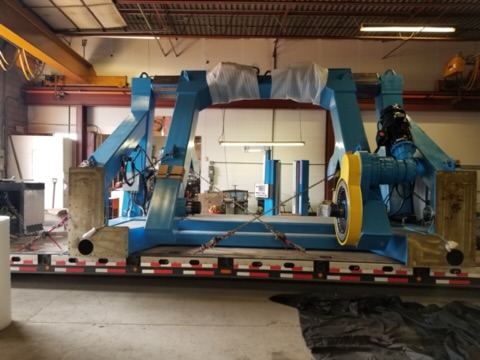
ust Ship It Logistics coordinated the cross-border transportation of a large twin-frame industrial machine from Detroit, Michigan, to Vaughan, Ontario, using a heavy-duty flatbed trailer with specialized cargo securement and professional protective tarping.
The customer needed to relocate industrial equipment featuring two elevated steel support frames, rotating mechanical assemblies, exposed hydraulic components, and a substantial structural base.
Unlike conventional freight, the machinery’s unusual shape created additional challenges during loading, cargo securement, and weather protection. Its exposed mechanical components also required careful preparation for open-deck transportation.
Our team coordinated a specialized flatbed transportation solution that accommodated the machine’s structural configuration while protecting its mechanical assemblies during the journey.
The project demonstrates how we approach complex industrial machinery shipments, combining appropriate transportation equipment, heavy-duty cargo securement, protective tarping, and cross-border logistics coordination.
From manufacturing equipment and heavy machinery to complex cross-border flatbed shipments, Just Ship It Logistics coordinates transportation solutions tailored to your cargo.
| Detail | Project Information |
| Project Type | Cross-border industrial machinery transportation |
| Industry | Industrial manufacturing |
| Transportation Date | October 14 – 15, 2026 |
| Origin | Detroit, Michigan, USA |
| Destination | Vaughan, Ontario, Canada |
| Transportation Distance | Approximately 420 km |
| Cargo | Twin-frame industrial machine with rotating mechanical assemblies |
| Number of Loads | 1 |
| Transportation Equipment | Heavy-duty open-deck flatbed trailer |
| Cargo Securement | Heavy-duty chains and binders |
| Cargo Protection | Protective component wrapping and professional industrial tarping |
| Transportation Scope | Cross-border specialized equipment transportation |
| Main Challenge | Transporting a tall, irregularly shaped industrial machine with exposed mechanical components |
| Just Ship It Logistics’ Role | Flatbed transportation coordination, cargo securement planning, protective tarping, and cross-border logistics |
| Project Objective | Deliver specialized industrial machinery with appropriate securement and weather protection |
| Project Result | Specialized transportation arrangement completed, with machinery secured and professionally tarped |
We were approached to coordinate the transportation of a large industrial machine from a supplier in Detroit, Michigan, to a manufacturing facility in Vaughan, Ontario.
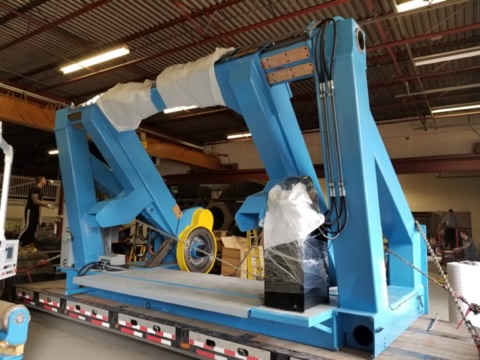
The equipment featured a substantial steel base supporting two elevated structural frames connected by upper cross-members. Within the structure were large rotating mechanical assemblies, hydraulic components, hoses, and additional industrial mechanisms.
The machinery’s configuration made it considerably different from conventional manufacturing freight.
Although the equipment could be transported as a single load, its elevated framework and irregular profile required careful consideration when selecting the trailer and planning cargo securement.
The customer also needed the machinery protected from precipitation, road spray, and debris during the cross-border journey.
Because the equipment was not suitable for the planned enclosed-trailer loading arrangement, we selected an open-deck flatbed transportation solution.
This provided the necessary accessibility for loading and securing the machinery while allowing us to arrange protective covering around its exposed components.
Our responsibility was to coordinate the equipment and transportation services needed to move the machine without requiring the customer to manage separate flatbed, securement, and tarping arrangements.
This shipment presented four main challenges that needed to be addressed before dispatch.
The first challenge was accommodating the machine’s substantial structural frame.
The equipment featured two tall steel assemblies extending above the main base, with rotating components and mechanical systems positioned within the structure.
This configuration created a significant vertical profile and required accessibility around the machinery during loading.
We coordinated a heavy-duty open-deck flatbed trailer suitable for the equipment’s structural footprint.
The open-deck configuration allowed the machine to be positioned lengthwise on the trailer without the interior height and loading restrictions associated with a conventional enclosed trailer.
The machinery’s loaded height, weight distribution, and structural support requirements were important considerations when selecting the transportation configuration.
The second challenge was cargo securement.
Industrial machines with elevated mechanical assemblies can have complex weight distribution, making securement planning particularly important.
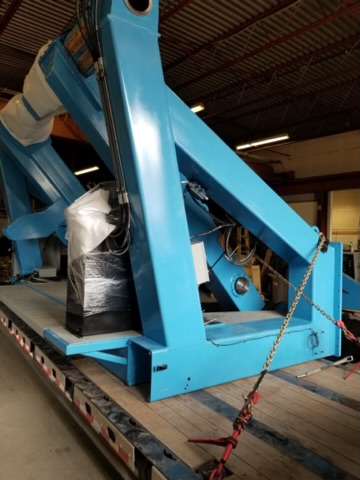
For this project, the machinery was positioned lengthwise on the flatbed trailer, with its substantial steel base resting on the deck.
Heavy-duty chains and binders were used to secure the equipment.
The securement arrangement needed to restrain the machine during braking, acceleration, turning, and normal highway movement.
We also needed to ensure that the securement system did not interfere with exposed mechanical assemblies or components requiring protection.
By addressing the equipment’s positioning and restraint requirements before tarping, we established a suitable foundation for the remaining transportation preparation.
The machinery contained several exposed mechanical assemblies, hoses, and rotating components.
These elements required additional attention because the equipment would be transported on an open-deck trailer.
The customer needed a solution that reduced direct exposure to weather and road conditions without requiring complete disassembly of the machine.
We coordinated protective wrapping around selected components before arranging the full industrial tarp.
This preparation helped provide additional protection to vulnerable areas while allowing the machine to remain in its transportation configuration.
For industrial equipment, these details are important because exposed mechanical components can require different handling and protection methods than the main steel structure.
The most distinctive challenge involved covering the machine’s elevated framework.
Standard flatbed cargo often has a relatively uniform shape, making tarp installation more straightforward.
This machine was different.
Its two elevated support frames, exposed rotating assemblies, and protruding mechanical components created an uneven profile.
We coordinated professional industrial tarping to accommodate this configuration.
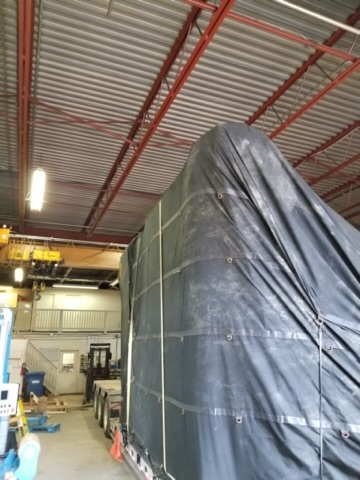
The protective covering extended over the elevated steel framework and down toward the trailer deck.
Particular attention was required around exposed edges, protruding components, and areas where the material could experience movement or abrasion during transit.
The completed tarping arrangement provided a protective barrier around the machinery while maintaining the advantages of open-deck transportation.
The customer benefit: We coordinated a specialized transportation solution combining appropriate flatbed equipment, heavy-duty machinery securement, and protective tarping, allowing the customer to move a complex industrial machine without independently arranging each service.
Our team coordinated the loading and securement of the twin-frame industrial machine onto a heavy-duty flatbed trailer.
The equipment was positioned lengthwise on the trailer deck, with its substantial steel base providing the primary support for the machine’s elevated structures and rotating mechanical assemblies.
One of the main considerations was the machinery’s unusual weight distribution.
The two elevated steel frames and connected mechanical components required careful positioning to maintain stability during transportation.
Heavy-duty chains and binders were used to secure the machine to the flatbed, with particular attention to the structural base and appropriate securement points.
We also needed to consider the exposed mechanical assemblies, hoses, and rotating components.
These parts required protection without interfering with the cargo securement system.
Once the machinery was positioned and secured, protective wrapping was applied to selected components before the full industrial tarp was installed.
The final tarping arrangement covered the elevated steel framework and extended toward the trailer deck, providing additional protection against rain, road spray, dust, and debris.
By coordinating cargo positioning, securement, and professional tarping as part of the same transportation plan, we prepared the industrial machine for its cross-border journey from Detroit to Vaughan.
Professional tarping was one of the most important aspects of the project.
The machine’s structural configuration created several areas where mechanical assemblies and components would otherwise remain exposed during transportation.
Unlike enclosed freight, open-deck machinery can encounter rain, snow, road spray, dust, and changing weather conditions.
We needed to arrange a protective covering suited to the machine’s unusual profile rather than relying on a standard rectangular load configuration.
The machinery’s two elevated steel frames also created potential contact points where tarping material could rub against the equipment.
To address these challenges, we coordinated protective wrapping for selected components and a full industrial tarp covering the larger machine structure.
The tarping arrangement needed to accommodate the machinery’s elevated frame, protruding components, and irregular shape.
Our objective was to protect the equipment while maintaining a secure, practical configuration for open-deck transportation.
Although tarping does not make a shipment completely waterproof, properly selected and installed protective covering can reduce direct exposure to environmental conditions.
The proposed transportation route connected Detroit, Michigan, with Vaughan, Ontario, covering approximately 420 kilometres.
The shipment would travel through the Detroit–Windsor freight corridor before continuing through southwestern Ontario toward the Greater Toronto Area.
Cross-border industrial machinery transportation requires additional planning compared with domestic freight.
Beyond selecting the appropriate trailer, we needed to consider customs documentation, border crossing arrangements, carrier coordination, and the receiving facility’s delivery requirements.
For industrial machinery, the equipment’s dimensions, weight, and commercial classification can affect the documentation and transportation arrangements required.
Because this machine featured an elevated steel framework, the loaded transportation height was an important consideration.
The route also needed to be suitable for the complete truck-and-trailer configuration.
| Requirement | Our Transportation Approach |
| Equipment configuration | Selected an open-deck flatbed arrangement suitable for the machinery |
| Cargo securement | Coordinated heavy-duty chains and binders |
| Mechanical component protection | Arranged protective wrapping and industrial tarping |
| Transportation height | Considered the elevated framework when reviewing trailer and route suitability |
| Customs documentation | Coordinated applicable shipment information with the relevant parties |
| Border crossing | Planned transportation through the Detroit–Windsor freight corridor |
| Delivery arrangements | Coordinated the receiving facility’s unloading requirements |
The project required the transportation arrangements to account for both the physical characteristics of the machinery and the requirements associated with international freight.
Our role was to coordinate a complete transportation solution for a specialized industrial machine.
The customer needed more than a carrier with an available trailer.
The machinery required suitable loading accommodation, securement, protective covering, and cross-border transportation planning.
We coordinated the flatbed arrangement and the resources required to prepare the equipment for transport.
This included selecting a suitable open-deck trailer, arranging cargo securement, and coordinating protective wrapping and industrial tarping.
The equipment’s structural design influenced each stage of the process.
The elevated framework affected trailer and clearance considerations. The substantial steel base influenced the securement arrangement. The exposed mechanical assemblies created additional requirements for cargo protection.
By treating these elements as connected parts of the same transportation assignment, we helped address the specific requirements of this industrial machinery shipment.
For the customer, this provided a coordinated solution without needing to independently source the specialized transportation and cargo protection services.
Just Ship It Logistics coordinated a specialized flatbed transportation arrangement for the twin-frame industrial machine.
The equipment was positioned on a heavy-duty open-deck trailer, secured with chains and binders, and protected with professional industrial tarping.
The transportation setup addressed three important requirements.
Appropriate transportation equipment: The flatbed configuration accommodated the machine’s substantial steel framework and elevated assemblies.
Heavy-duty cargo securement: Chains and binders were used to restrain the machinery on the trailer.
Protective tarping: The exposed machinery was covered to reduce direct exposure to weather and road contaminants.
The project demonstrates our approach to coordinating transportation for complex industrial equipment with irregular structural profiles.
By combining specialized trailer selection, cargo securement, and protective covering, we provided a transportation arrangement tailored to the machinery’s requirements.
This project demonstrates that industrial machinery transportation should be planned around the specific equipment being moved.
Not all heavy machines require the same trailer or protective arrangements.
Some manufacturing equipment can be transported inside conventional enclosed trailers, while larger machines with elevated structures or unusual dimensions may require open-deck transportation.
The twin-frame machine in this project required a solution that accommodated its structural configuration while protecting exposed mechanical components.
Before arranging industrial machinery shipping, manufacturers should establish accurate equipment dimensions, weight, lifting requirements, and suitable securement points.
They should also identify any components requiring additional protection.
For cross-border transportation, customs documentation, route restrictions, and potential permit requirements should be considered before dispatch.
The project illustrates how appropriate planning and specialized transportation coordination can address the challenges associated with moving industrial machinery beyond standard freight configurations.
The machinery's structural profile and loading requirements made an open-deck configuration more suitable for the transportation arrangement. The flatbed allowed the equipment to be positioned, secured, and covered without the interior height and loading restrictions of a conventional enclosed trailer.
The machinery was secured using heavy-duty chains and binders. The arrangement was planned around the equipment's structural base, weight distribution, and suitable securement points.
The equipment contained exposed mechanical assemblies, hoses, and rotating components. Protective wrapping and industrial tarping were arranged to reduce direct exposure to precipitation, road spray, dust, and debris.
Yes. Industrial machinery can be transported between Canada and the United States using appropriate flatbed or specialized heavy-haul equipment. Customs documentation, route planning, and permits may be required depending on the shipment.
Yes. Just Ship It Logistics coordinates flatbed transportation and protective tarping arrangements for industrial machinery and other specialized freight requiring additional cargo protection.