
The short version: In Canada, the calendar quietly rewrites the rules of freight winter road regulations, spring-thaw weight limits, and the Q4 demand peak each change what carriers can move, when, and at what cost. None of these shifts is dramatic on its own, but together they reward shippers who plan ahead. As a freight broker, Just Ship It Logistics coordinates capacity across our carrier network so your shipments keep moving through every seasonal change.
Vibrant fall leaves and the complexities of logistics seem unrelated at first, but in Canada the two intersect constantly. As the seasons shift, weather and road conditions directly affect supply chains, especially road transportation. Falling leaves create slippery driving; winter and the spring thaw then bring rules that change what carriers can legally move and when. For shippers, transit times, capacity, and rates all move with the calendar.
Seasonal logistics runs deeper than the day’s forecast, too. The fall harvest pulls hard on refrigerated capacity, retailers rotate inventory for the colder months, and e-commerce climbs toward its Q4 peak tightening trucks and pushing rates up just when deadlines matter most. Cross-border shippers add customs timing on top. These parts rarely move in isolation, and a delay in one a storm, a permit blackout, a border backup tends to cascade into the others.
As a freight broker, Just Ship It Logistics coordinates capacity across our carrier network matching the right mode and carrier to the season, the lane, and the rules in force. Understanding these connections helps you plan ahead instead of reacting.
Autumn is the gentle warning before winter. Falling leaves settle on roads and rail lines and, once wet, turn to a slick film that lengthens braking distances and raises the risk of incidents which is why road authorities step up maintenance and clearing through the season. Shorter daylight hours mean more of the driving day happens in the dark, and early frost can catch a lane off guard well before the first real snowfall. For freight, the effect is subtle but real: routes slow, schedules loosen, and the reliable summer transit time you planned around starts to drift. The carriers that stay dependable are the ones already adjusting routing and timing for the conditions ahead, rather than reacting to the first storm.
Season signal: Fall is the freight world’s early-warning system. Transit times start drifting before the first snow build a little slack into schedules now, not in December.
Winter is where the calendar stops being a suggestion and becomes law and the law isn’t the same from one province to the next. Weather alone reshapes the season: roughly one-third of all collisions in Canada happen between November and February, and close to 30% occur on wet, snowy, or icy roads, according to the RCMP. On top of that risk sits a patchwork of equipment rules. Quebec has the strictest, requiring winter tires on vehicles registered in the province from December 1 to March 15 though heavy trucks are exempt from that particular rule as set out by the Société de l’assurance automobile du Québec. British Columbia goes further for freight specifically: winter tires or chains are required on designated highways from October 1 to April 30 (some routes end March 31), with commercial chain-up requirements that do apply to trucks, per the BC government. Ontario, Alberta, Saskatchewan, and Manitoba, by contrast, don’t mandate winter tires at all; they’re recommended, not required.
| Province | Winter tire rule | Dates | Applies to trucks? |
|---|---|---|---|
| Quebec | Mandatory on registered vehicles | Dec 1 – Mar 15 | No – heavy trucks exempt |
| British Columbia | Required on designated highways | Oct 1 – Apr 30 (some routes Mar 31) | Yes – plus commercial chain-up |
| Ontario | Recommended, not required | N/A | No mandate |
| Alberta | Recommended, not required | N/A | No mandate |
| Saskatchewan | Recommended, not required | N/A | No mandate |
| Manitoba | Recommended, not required | N/A | No mandate |
*Rules vary by province and always confirm compliance for the specific route.
For a shipper whose freight crosses provincial lines, that’s the whole point: a carrier equipped for an Ontario lane may not be compliant for a designated BC route through the mountains. Beyond equipment, winter simply moves slower highway closures, chain-up delays, and reduced speeds through passes all stretch transit times, and a single storm system can idle an entire corridor for hours. Planning winter lanes with realistic transit windows, and with carriers already set up for the route, is what keeps a shipment from sitting at a closure while the delivery deadline passes.
Cold truth: Winter equipment rules vary by province; Quebec mandates winter tires, BC requires them on designated highways for trucks, and Ontario and the western provinces don’t. On cross-province lanes, carrier compliance for the specific route is what keeps your freight legal and moving.
The season that surprises shippers most isn’t winter, it’s spring. As frost leaves the ground, roadbeds soften and lose bearing strength, and provinces impose temporary weight limits to protect them. In Ontario, under the Highway Traffic Act, reduced-load restrictions cap weights at roughly 5,000 kg (about 11,000 lb) per axle on designated highways during spring thaw, and annual and project overweight permits are generally suspended, with timing running anywhere from March – April to as late as March – June depending on the highway, as published by Ontario 511. For shippers, this can turn a load that ran fine in January into one that needs to be split across two trucks, re-routed onto exempt highways, or rescheduled entirely in March. Municipalities can also post their own restrictions on local roads, so the same lane may be legal one week and posted the next. Coordinating dense and oversized freight around these windows including heavy haul moves that depend on permits is exactly where a broker earns its keep.
Thaw watch: From roughly March to June, per-axle weight limits drop and overweight permits pause across much of Ontario. Dense and oversized loads need earlier planning in spring, not last-minute booking.
Head west and the same thaw problem takes on a different name and rhythm. Across Western Canada, spring weight limits are called road bans, and they can bite hard: Alberta’s provincial road-ban program reduces the maximum weight allowed on affected roads during thaw, with many rural roads dropping to around 75% of their normal axle limit, as set out by the Government of Alberta. The timing is weather-driven rather than fixed to a calendar date; bans typically run somewhere from March into June, triggered by thaw-depth readings which means dispatchers have to monitor active orders rather than assume a set window. The wrinkle unique to Western Canada is agriculture: road bans land at the same time producers need to move grain and inputs, so provinces and municipalities juggle exemptions and route agreements to keep the farm economy running without wrecking the roads. For anyone shipping industrial, oilfield, or agricultural freight across Alberta, Saskatchewan, or Manitoba in spring, a legal route is a moving target that a broker tracks so you don’t have to.
| Name | Ontario | Alberta |
|---|---|---|
| Common name | Reduced-load period | Road bans |
| Typical limit | 5,000 kg (11,000 lb) per axle | Often 75% of normal axle weight on rural roads |
| Timing | March – June, by highway class | March – June, weather/thaw-depth driven |
| Overweight permits | Generally suspended | Restricted; exemptions/route agreements possible |
| Where to check | Ontario 511 | Government of Alberta |
*Both protect softened roadbeds during thaw; dense and oversized freight needs earlier planning in spring either way.
Road-ban read: Out west, spring “road bans” cut axle weights on rural roads for weeks at a time on a weather-driven schedule. Western spring freight needs a route confirmed against live bans, not last year’s map.

Fall is synonymous with seasonal goods: pumpkins, apples, Thanksgiving and holiday inventory and getting them to shelves on time depends on planning that anticipates the surge. Temperature-sensitive products lean heavily on refrigerated (reefer) capacity, and that capacity is under steady pressure: Canada’s cold chain logistics market was valued at roughly US$6 billion in 2025 and is forecast to keep growing, per Mordor Intelligence. Harvest season concentrates that demand, as produce, food, and beverage volumes spike at once and reefer trailers get harder to secure and because reefers can’t simply be swapped for dry vans, the crunch is sharper than in general freight. Booking refrigerated freight ahead of the peak rather than into it is the difference between arriving fresh and on time and paying spot-market premiums for whatever’s left.
Cold-chain check: Reefer space is finite and tightest at harvest. Lock in refrigerated capacity before the peak, not during it.
Many businesses reshape their supply chains as the seasons turn. Apparel retailers rotate to fall and winter inventory; manufacturers and distributors change lanes and volumes; construction and landscaping wind down in the north as heating-season goods ramp up. The businesses that avoid seasonal disruption are the ones that plan capacity before the shift, not during it whether they’re moving a few pallets by less-than-truckload or full truckloads across the country. The earlier the plan, the better the rate and the more reliable the transit, because carriers price and prioritize committed volume ahead of last-minute spot freight.
Plan-ahead play: Seasonal supply-chain shifts reward early planners with steadier transit and better rates. The calendar is predictable use it.
Online businesses see a major lift each fall, and the Black Friday – Cyber Monday window is the sharpest spike of the year: the Retail Council of Canada projected Canadians would spend about $9.3 billion over the Black Friday and Cyber Monday period, as reported by Retail Insider. What’s often underestimated is the freight effect: as everyone ships more at once, capacity tightens and rates climb through Q4 the annual peak. Meeting delivery commitments through that window depends on locking in reliable capacity early, since the shippers who wait until December are competing for whatever trucks are left at whatever the market will bear. For businesses shipping palletized freight to fulfillment centres or retailers, LTL shipping is often the most cost-effective mode through the surge.
Peak prep: Q4 is freight’s busiest, priciest window. Booking capacity early protects both your margins and your delivery promises.
Seasonal rates aren’t random; they’re the sum of a few predictable pressures.
The first is capacity: Canada’s carrier network runs tight to begin with, and Trucking HR Canada data shows the trucking sector’s job-vacancy rate has run roughly 1.5 times the average across the Canadian economy, as reported by Inside Logistics. When peak-season or harvest demand lands on an already-thin driver pool, prices move.
The second is fuel: cold-weather operating conditions and winter demand tend to lift diesel prices, and fuel surcharges rise with them. And in severe weather, the deciding factor isn’t price at all; experienced carriers simply park until conditions are safe, so the shippers who move freight mid-storm are paying a premium for the few willing to run it.
The third is seasonal accessories; winter weather drives more limited-access, appointment, and re-delivery charges as sites get harder to reach and hours shrink.
And the fourth is the general rate increases most LTL carriers apply on their own annual schedule, often early in the year. A broker’s job is to read all of this and route your freight to the mode and carrier that keeps the total landed cost sensible, not just quote the lowest line-haul.
Rate reality: Seasonal rates are driven by capacity, fuel, accessories, and carrier rate increases not luck. Understanding the drivers is how you plan a budget so the season won’t blow up.
Ask anyone who books freight for a living what winter actually looks like, and a few themes come up every time. The first is that severe weather doesn’t just slow freight down it can stop it. When a real storm hits, experienced carriers park, and no rate changes that in the moment: the risk of an accident, and the insurance fallout that follows, outweighs any single load. When trucks do keep rolling through bad conditions, they rightly command premium rates for taking on that risk. A shipper who insists on moving freight mid-storm is really asking for the small pool of carriers willing to run it and paying accordingly.
The second theme is the delay you can’t see. Freight moves through a connected network, so a blizzard in one region backs up terminals and trucks far beyond it days later. A shipment can sit “weather delayed” under a clear blue sky in one city because the storm that caused it hit a province away and rippled across the network. It’s rarely an excuse, it’s how a national network absorbs a shock in one place.
The third is cost and accountability. If a receiver closes for a storm and the truck arrives on time, someone pays for that layover or detention and the cleanest outcome is when those accessorial terms were agreed before the load ever moved, not argued over after. Weather is nobody’s fault, which is exactly why the terms need to be set in advance.
The shippers who ride all this out best have stopped assuming everything runs on schedule and started building in slack extra lead time, backup carriers, a plan B. That’s where a broker who keeps you informed earns its place: instead of a black-box “weather delay,” you get a straight answer, the reason behind it, and the next option.
Real talk: In a serious storm, capacity stops before it gets expensive, delays cascade from storms you can’t see, and weather costs get disputed after the fact. The fix is slack, clear terms up front, and a partner who tells you what’s actually happening.
For anyone shipping between Canada and the US, the border adds a seasonal layer of its own. Volume is enormous and constant roughly 30,000 trucks cross the Canada–US border every day, according to the Library of Parliament and that traffic thickens during the Q4 peak, when customs processing and gateway congestion can add hours to a lane that ran clean in summer. Winter weather at the crossing compounds it, and incomplete paperwork is far more costly when the queue is already long. Planning cross-border freight and customs documentation ahead of the rush keeps seasonal shipments from stalling at the line.
Border brief: Border congestion is seasonal too. Prep customs and cross-border lanes before the Q4 peak, not as freight is already rolling toward the crossing.
Regions famous for fall foliage draw waves of visitors, and that influx ripples straight into freight. Restaurants, retailers, and hospitality operators in peak-season destinations need reliable inbound deliveries of food, beverage, and retail goods precisely when local roads are busiest and hardest to schedule around. The same pattern repeats around ski season and summer resort towns: demand concentrates in a region for a few months, and inbound freight has to thread through congestion and constrained delivery windows. Coordinating consistent deliveries into these markets is a logistics challenge in its own right, and one that benefits from a broker managing carrier timing around the crowds.
Demand signal: Tourist season doesn’t just fill hotels it strains inbound freight into those regions. Reliable delivery scheduling matters most when the roads are fullest.
Fall generates its own seasonal freight, too. Municipalities and contractors coordinate the collection and hauling of leaves, yard waste, and organics to composting and disposal sites often on tight, weather-driven schedules that mirror the seasonal contract work seen in snow-removal supply, salt and aggregate distribution, and spring cleanup. Like any seasonal contract volume, it depends on dependable capacity and coordination to keep communities running smoothly through the busy stretch.
Contract corner: Seasonal contract volume lives or dies on scheduled, reliable capacity the same discipline that keeps commercial freight on time.
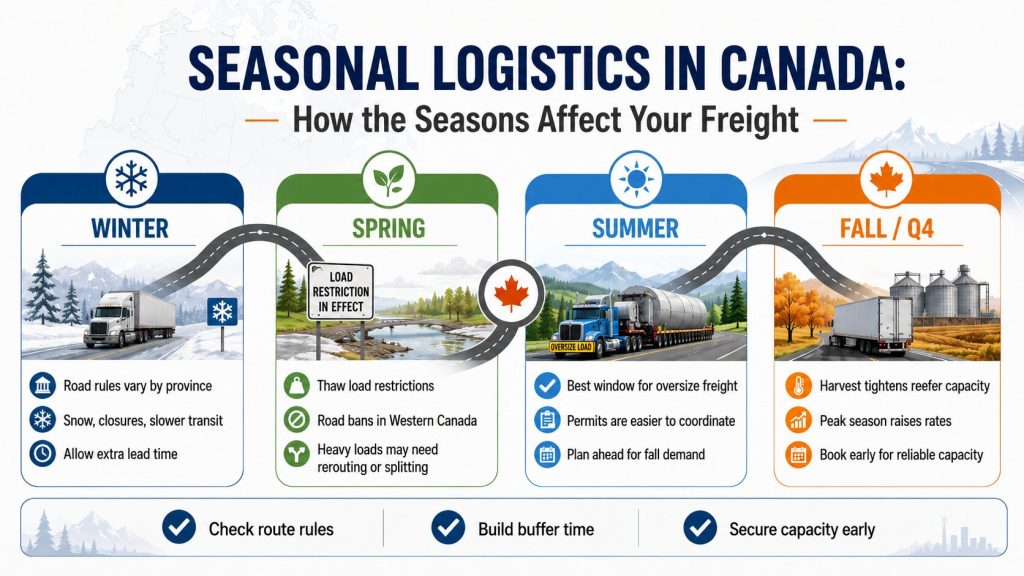
The seasons are predictable, so the smartest shippers plan against them rather than reacting each time. Here’s the year at a glance:
Winter (Dec – Feb). Build longer transit windows into cross-province and mountain lanes, confirm carriers are equipped for designated winter-tire and chain routes, and expect fuel surcharges and weather delays. Book full-truckload capacity early on critical lanes.
Spring (Mar – Jun). Watch reduced-load restrictions and western road bans on any heavy or dense freight; plan to split, re-route, or reschedule oversized loads, and confirm each route against live provincial postings rather than assumptions.
Summer (Jul – Aug). The most open window of the year is a good time to move oversized and project freight while permits are unrestricted, and to lock in fall and Q4 capacity before demand climbs.
Fall (Sep – Nov). Harvest tightens reefer capacity and the Q4 e-commerce ramp begins. Book refrigerated and peak-season capacity well ahead, and finalize cross-border documentation before the holiday crush.
The year-round play: Every season has its own freight signature plan: winter for weather, spring for weight limits, summer for open permits, and fall for capacity. Mapped in advance, the calendar becomes a plan instead of a surprise.
Each of these shifts slick fall roads, winter equipment rules, spring-thaw weight limits, western road bans, harvest reefer demand, the Q4 peak, and border timing is a moving part, and they rarely move alone. As a freight broker, Just Ship It Logistics coordinates capacity across our carrier network and matches each shipment to the right mode, the right carrier, and the rules in force on the lane. That means you’re not tracking provincial regulations, monitoring live road bans, or chasing scarce trailers yourself; you’re working with a partner who does it year-round, across every mode from LTL to heavy haul to cross-border, and who keeps you informed when the weather doesn’t cooperate.
On the surface, autumn can look logistically quiet next to winter. But in Canada the season sets off a chain of shifts, fall road conditions, winter road rules, spring-thaw load limits, western road bans, harvest capacity, the Q4 demand peak, and seasonal border congestion that each reshape what can move, when, and at what cost. Individually they’re easy to overlook; together they separate the shippers who plan from the ones who scramble. Partnering with a broker who tracks both the rules and the capacity turns the calendar from a risk into something you can plan around.
The whole picture: Seasonal freight isn’t one challenge, it’s a year-round sequence of them. Plan ahead, lane by lane and season by season, and the calendar works for you instead of against you.
Yes, if your freight is heavy or dense. During spring thaw, Ontario caps weights at roughly 5,000 kg (about 11,000 lb) per axle on designated highways and suspends overweight permits, typically from March through as late as June, depending on the route and conditions.
Road bans are the term used across Western Canada for spring weight restrictions. In Alberta, they reduce allowable axle weight on affected roads often to around 75% of normal on rural routes on a weather-driven schedule through the thaw. They serve the same purpose as Ontario's reduced-load restrictions under a different name.
Demand and constrained capacity. The Q4 peak Black Friday through the holidays pushes far more freight into the network at once, while winter road rules, weather, fuel costs, and a tight driver pool limit how many carriers can run key lanes. Booking capacity early is the best defence against seasonal rate spikes.
It depends on the situation and the terms agreed up front. If a receiver closes for a storm and the carrier arrives on time, a layover or detention charge typically applies and is passed to the shipper. Because weather is outside everyone's control, the cleanest approach is agreeing accessorial terms before the load moves.
Generally summer. Between the end of spring thaw restrictions and the start of the next winter, overweight and oversize permits are unrestricted on most routes, making it the cleanest window for project, industrial, and heavy-haul moves.
Earlier than most shippers do. For Q4 peak and harvest-season reefer capacity, planning weeks ahead secures better rates and reliable transit. For dense or oversized loads in spring, planning around thaw restrictions and road bans before they take effect avoids costly re-routes.
Yes. A broker monitors provincial rules, live road bans, and carrier capacity year-round, then matches each shipment to a carrier equipped and compliant for the lane and season so you get reliable coverage without tracking the regulations yourself.