Published by Marcus Pustijanac – Owner & CEO, Just Ship It Logistics, with 35+ years arranging LTL, full truckload, and cross-border freight for Canadian shippers.
Published July 23, 2026 · Last updated August 10, 2026
The LTL vs FTL decision comes down to a question most guides answer badly: how much of a trailer does your freight actually need? Less-than-truckload (LTL) suits small shipments that share space with other companies’ freight. Full truckload (FTL) fits a full trailer or any load urgent or fragile enough to want a truck of its own. Partial truckload (PTL) covers the awkward middle. But pallet count is only the starting point. The mode that’s genuinely cheapest and most reliable for your shipment depends on its density, the lane it runs, and how much handling it can tolerate. Here’s how to choose.
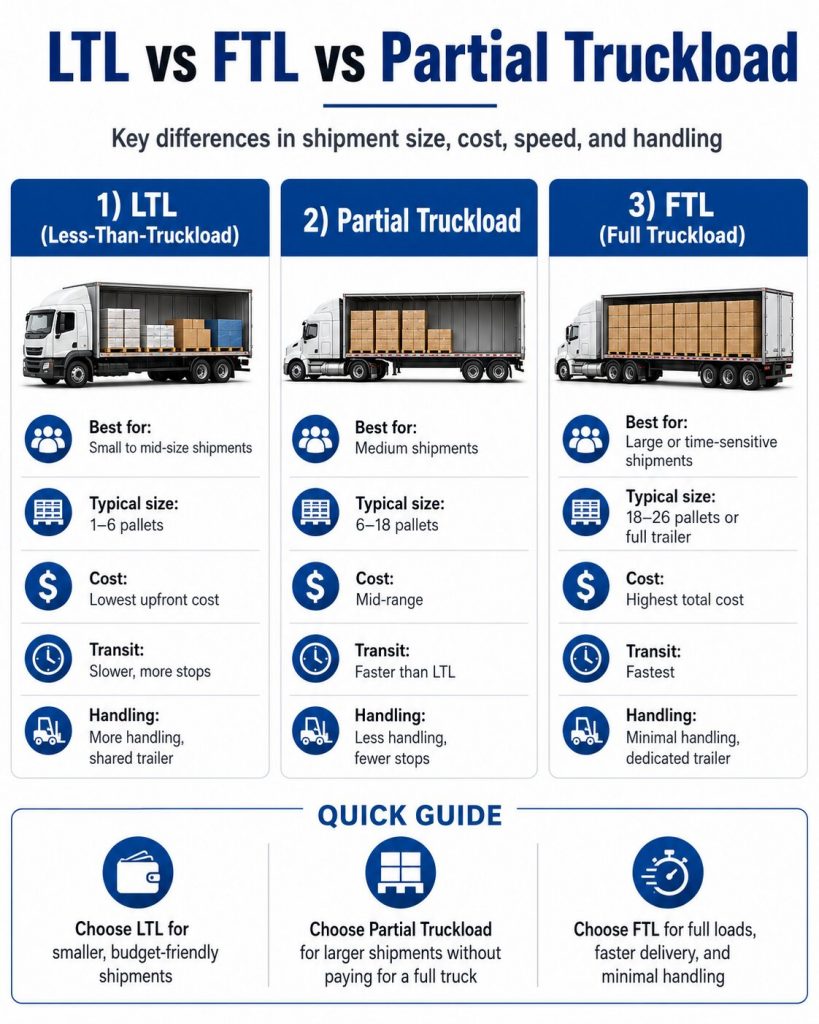
LTL moves small shipments by combining your freight with loads from other shippers on the same trailer. You pay for the space and weight you use rather than a whole truck, which makes it the most cost-effective option for shipments that don’t come close to filling a trailer typically one to eight standard skids.
The trade-off is handling. LTL freight moves through a hub-and-spoke network, so it’s loaded, sorted, and reloaded at terminals between pickup and delivery. That means slightly longer transit times and more opportunities for damage, which is why packaging and correct freight classification matter more with LTL than any other mode.
LTL fits best when: you’re shipping small, palletized, reasonably durable B2B freight; you have flexible timing; or you’re distributing to several locations without filling a truck for any of them.
Takeaway: LTL is the cheapest way to move small, durable freight as long as it’s packaged and classified correctly, because handling and freight class drive most of its cost and risk.
FTL means your shipment gets the entire trailer. Even if it doesn’t fill every inch, the truck runs exclusively for your freight, moving direct from pickup to delivery with no terminal stops in between.
That directness is what you’re paying for. FTL delivers the fastest, most predictable transit and the lowest damage risk because the freight is handled once at each end. For large or full-trailer shipments, it’s also the lowest cost per unit you’re spreading one lane rate across a full load instead of paying per pallet.
FTL fits best when: you have enough freight to fill or nearly fill a trailer; the shipment is time-sensitive, high-value, or fragile; or you simply want a dedicated, direct run with no shared handling.
Takeaway: FTL costs more up front but wins on speed, predictability, and per-unit cost once your freight fills or needs a whole trailer.
Partial truckload is the option most shippers don’t know they have. It’s for loads that are too big or too many pallets for economical LTL, but not enough to justify paying for a full trailer typically in the range of six to eighteen pallets.
Unlike LTL, a partial load isn’t consolidated and re-sorted through terminals. It travels on a dedicated portion of a truck with minimal handling, which means faster transit and lower damage risk than LTL often at a better rate than either LTL or FTL for that awkward mid-size range. It’s also a strong fit for freight you’d rather not have handled repeatedly, even when the pallet count alone might qualify for LTL.
PTL fits best when: your shipment is mid-sized, when a full truck would mean paying for empty space, or when the freight is fragile enough that fewer touches are worth more than the lowest headline rate.
Takeaway: Partial truckload fills the gap between LTL and FTL dedicated space and minimal handling for mid-size loads, without paying for a full trailer.
| Name | LTL | Partial Truckload | FTL |
|---|---|---|---|
| Shipment size | ~1 – 8 standard skids | ~6 – 18 pallets | Full trailer, up to ~26 pallets / ~45,000 lb |
| Trailer space | Shared with other shippers | Dedicated portion, not consolidated | Entire trailer, exclusive |
| Handling | Sorted through multiple terminals | Minimal stays on the truck | Minimal direct, one truck |
| Pricing basis | Freight class + weight + dimensions | Space (linear feet) + weight | Flat rate for the lane |
| Transit speed | Slowest (hub-and-spoke) | Faster than LTL | Fastest (direct) |
| Damage risk | Higher (more touches) | Lower | Lowest |
| Best for | Small, durable, non-urgent freight | Mid-size loads, or fragile freight you don’t want re-handled | Large, urgent, high-value, or full-trailer loads |
The cleanest way to read this table: the real dividing line isn’t pallet count, it’s consolidation. LTL shares a trailer and gets handled repeatedly; partial and full truckload give your freight dedicated space and minimal handling. That’s why a load that technically fits LTL on size can still be better off on a dedicated truck if it’s fragile or time-sensitive.
Takeaway: Decide on consolidation and handling first, then size a load that fits LTL on paper may still belong on a dedicated truck if it’s fragile or time-critical.
Shipment size gets you to a shortlist of modes. These four factors decide which one is actually cheapest for your freight.
Density, not just weight. Light but bulky freight is where shippers get surprised. On LTL, low density pushes your freight into a higher (more expensive) class. On FTL, it can fill a trailer by volume long before it hits the weight limit, so you pay for a full truck to move air. In our experience quoting Canadian freight, low-density shipments are the ones that come back priced higher than expected, so knowing your freight’s density before you request a quote is the single most useful number you can bring.
Freight class and the recent NMFC change. LTL pricing runs on freight classification, and the National Motor Freight Classification system has shifted much of that classification toward density. If your product’s class isn’t set correctly, LTL quotes come back higher than they should another reason dense, well-packaged freight is where LTL wins.
Lane and dwell time. FTL is priced per lane, so an imbalanced or thinly served route costs more regardless of what you’re shipping. Long wait times at tight loading docks add detention charges — and because a full truck has no network to fall back on, one missed appointment can stall the whole shipment. LTL and partial loads absorb that kind of disruption more gracefully.
Accessorials. Liftgate service, limited-access or residential-adjacent delivery, inside delivery, and appointment scheduling all add cost across every mode. Flagging them upfront keeps your quote accurate and avoids surprises on the invoice.
Takeaway: Two shipments of the same weight can price very differently know your freight’s density, class, lane, and accessorials before you quote, and the number will make sense.
Start with size, then adjust for the factors above:
Then pressure-test the choice:
If you’re between two modes after that, the right move is usually to quote both. A broker with access to multiple carriers can price the same shipment across modes and show you the real difference rather than guessing.
Takeaway: Use size to shortlist a mode, then let density, lane, dock constraints, and handling tolerance make the final call and quote more than one mode when it’s close.
All modes run cross-border, but customs adds a layer that changes the calculus. Consolidated LTL crossing the border means your freight is part of a mixed load being cleared alongside other shippers’ goods, which can add time if any one shipment on the trailer hits a customs snag. A dedicated truckload clears as a single consignment, which is often simpler for time-sensitive or high-value cross-border freight.
The bigger cost driver cross-border is coordination. When freight and customs clearance are handled by separate parties, shipments stall in the gap between them. Pairing the right mode with cross-border freight between Canada and the U.S. under one point of contact and filing correctly with the Canada Border Services Agency is usually what keeps a border shipment on schedule.
Takeaway: Cross-border freight succeeds or stalls on coordination pairing the right mode with customs clearance under one point of contact is what keeps it moving.
“After more than 35 years in this business, the shippers who overpay are almost always the ones who picked a mode before they understood their freight. Our job as a broker isn’t to sell you a truck — it’s to look at what you’re actually moving and put it on the right one. And if it’s the kind of load other brokers won’t touch, that’s exactly the call we want.”
— Marcus Pustijanac, Owner & CEO, Just Ship It Logistics
As a freight brokerage, not an asset-based carrier Just Ship It isn’t tied to one fleet or one mode. With more than 35 years arranging freight across Canada and cross-border, we can quote your shipment as LTL or full truckload across a wide carrier network and match it to whichever genuinely fits, rather than steering you toward the trucks we happen to own. Our model carries no volume commitment, so it works whether you ship once a quarter or every week.
It also means we’ll take on the freight and the lanes other brokers pass on the awkward dimensions, the hard-to-serve routes, the shipments that don’t fit a neat category. From the first quote to final delivery, you work with one point of contact who knows the load.
Not sure which mode fits your next shipment? Get a freight quote and we’ll price it across modes so you can see the real trade-off.
Takeaway: A broker quotes your freight across carriers and modes to find the real best fit not the truck they happen to own.
The LTL vs FTL question is rarely settled by shipment size alone. LTL wins on cost for small, durable, flexible freight; FTL wins on speed and predictability for full or urgent loads; and partial truckload quietly covers the mid-size and fragile-freight gap that trips up shippers who only know the two extremes. Match the mode to your freight’s density, lane, and handling tolerance and when it’s close, quote more than one.
Just Ship It Logistics is a Canadian freight brokerage based in Barrie, Ontario, arranging LTL, full truckload, heavy haul, and cross-border shipping across North America for more than 35 years.
LTL is usually cheaper for small shipments because you only pay for the space you use. FTL becomes cheaper per unit once your freight fills, or nearly fills, a trailer you spread one lane rate across the whole load. The real breakpoint depends on your freight's density and lane, not size alone.
LTL stands for "less than truckload" freight that doesn't fill a trailer and shares space with other shippers' loads. FTL stands for "full truckload" a shipment that takes an entire trailer for itself. Both are road freight modes; the difference is whether your load travels alone or consolidated with others.
Use LTL when your shipment is small, roughly one to eight skids durable enough to handle terminal sorting, and not tightly time-sensitive. Choose FTL when you have a full or near-full trailer, or when the freight is urgent, fragile, or high-value enough to justify a dedicated, direct truck.
LTL generally covers about one to eight standard skids. A full truckload fills a trailer usually up to around 26 pallets or roughly 45,000 lb, depending on freight weight and dimensions. Between the two, mid-size loads of six to eighteen pallets fall into partial-truckload territory.
FTL is faster. Because a full truckload travels direct from pickup to delivery with no terminal stops, it offers the quickest, most predictable transit. LTL moves through a hub-and-spoke network, getting sorted at terminals along the way, which adds time. For urgent freight, FTL is almost always the better choice.
It depends on shipment size, but customs coordination matters more than mode. A dedicated full truckload clears as a single consignment, which is often simpler for time-sensitive cross-border freight, while LTL works well for smaller loads. Either way, pairing freight with customs clearance under one point of contact keeps border shipments on schedule.
Start with shipment size, then weigh density, lane, delivery constraints, and how much handling your freight can tolerate. When two modes look close, quote both. As a broker, Just Ship It can price your shipment as LTL or full truckload across multiple carriers and match it to whichever genuinely fits.