
Freight class is the single largest controllable variable in less-than-truckload pricing, and it is the one Canadian shippers get wrong most often. If you ship pallets to the United States, you have almost certainly had this conversation: you booked at class 70, the carrier inspected the skid, and the invoice came back at class 125 with an inspection fee attached. Nobody explained why. The rate went up 40 percent and the quote you gave your customer no longer covers the freight.
Use the calculator below to get your density-based class in metric or imperial, then read on for how the system works, when it applies in Canada, and how to keep your freight from being reclassified.
Enter the palletised shipment — including the skid. Density is calculated across all pieces, then matched to the NMFC density scale.
Measure the load, not the product. Include the pallet in both the dimensions and the weight, plus any overhang or wrap. A standard wooden skid adds roughly 30–50 lb (14–23 kg) that the terminal scale will find.
00
Enter dimensions to calculate
This is a density-based estimate, not a final classification. The NMFC evaluates four characteristics; only the first is calculable from dimensions and weight. Item-specific listings override density where stowability, handling or liability apply, and classes 77.5, 110, 150, 200 and 500 are not reachable through the density scale at all.
Cross-border Canada–USA freight requires an accurate NMFC item number and class on the bill of lading. On Canadian domestic lanes, rating practice varies by carrier — some rate on class, others on cubic weight, linear feet or skid count. Confirm which basis applies to your lane before you book. The authoritative commodity source is the NMFTA ClassIT database.
Switch to cm / kg if you measure in metric, and enter the skid as it will be tendered, pallet included. Add a row for each differently sized piece.
The calculator returns a density-based estimate only. It cannot see stowability, handling, or liability, so an item-specific NMFC listing will override it, and classes 77.5, 110, 150, 200, and 500 are not reachable through the density scale at all. Treat the number as a strong starting point and a quoting sanity check, not a final classification.
One thing to know about how it works: it totals the weight and the cube across every piece you enter, then divides. That is one of two methods carriers use for shipments with several pieces. The other is to calculate each handling unit separately, which gives a different answer whenever your pieces differ in density. If you are shipping mixed pallets, run each skid through the calculator on its own as well as together, and compare.
Freight class is a standardized rating system published in the National Motor Freight Classification (NMFC) that assigns every commodity a number between 50 and 500 across 18 class levels, based on density, stowability, handling, and liability. Lower classes are denser, easier to handle, and cheaper to ship. The class on your bill of lading is what the carrier multiplies against its rate base to price the shipment.
The NMFC is maintained by the National Motor Freight Traffic Association (NMFTA), a U.S. carrier association based in Alexandria, Virginia. A pallet of canned goods might rate class 60. A pallet of empty plastic planters might rate class 250, even though the planters weigh a fraction as much, because they take up the same trailer space and the carrier cannot sell that space to anyone else.
The NMFC is not a fixed rulebook. NMFTA updates it twice a year, and each update can move products to new item numbers or new classes. See what changed in 2026.
An NMFC code, also called an NMFC item number, is the identifier that points to a commodity’s entry in the classification. The item number is what appears on the bill of lading; the freight class comes from that entry. Some entries assign one flat class. Most now assign class based on the shipment’s measured density.
Density is weight divided by the space the shipment occupies, expressed in pounds per cubic foot (pcf). This is the dominant factor and the only one you can influence at the loading dock.
Stowability covers whether freight loads and stacks well alongside other shipments. Odd shapes, overhang, and anything that cannot be stacked push class up because the carrier loses usable trailer space above and around it.
Handling covers whether the freight needs special equipment or care. Fragile items, loose pieces, and anything that needs a forklift attachment or two people to move rate higher.
Liability covers the carrier’s exposure to loss, damage, and theft. High-value or easily damaged goods rate higher because a claim costs the carrier more.
A commodity with no handling, stowability, or liability concerns is now almost always rated purely on density.
Freight class is required on all Canada – U.S. cross-border LTL freight and all U.S. domestic freight. On purely domestic Canadian lanes it depends on the carrier: many reference the same NMFC classification, while others rate on dimensional or cubic weight, linear feet, or skid count under their own tariffs. Confirm which basis your carrier uses before you book a domestic move.
That split is what most guides written for U.S. audiences miss, and it cuts both ways. Assuming class always applies is as costly as assuming it never does.
| Lane | Does NMFC class apply? | What drives the rate |
| Canada to U.S. (cross-border LTL) | Yes, required | NMFC item number and class on the BOL |
| U.S. to Canada (cross-border LTL) | Yes, required | NMFC item number and class on the BOL |
| U.S. domestic | Yes, required | NMFC item number and class on the BOL |
| Canada to Canada (domestic LTL) | Depends on the carrier | Either NMFC class, or cubic/dimensional weight, linear feet, or skid count |
On domestic Canadian lanes, practice is genuinely mixed. Some carriers reference the NMFC directly. Others price on the space your freight occupies (cubic weight, linear feet, or straight skid count) using their own published tariffs. Neither approach is unusual, and the only reliable way to know is to ask the carrier or check the tariff before you book. A quote that came back cheaper than expected on a domestic lane often reflects a different rating basis rather than a better rate.
Cross-border is where the ambiguity disappears. That freight moves on U.S. carrier tariffs, and those tariffs rate by NMFC class. An Ontario manufacturer shipping to Ohio needs the correct item number and class on the bill of lading, in the same way a shipper in Ohio does.
First, the density discipline you need for cross-border shipments pays off on your domestic freight anyway. Cubic-weight pricing and density-based classification reward the same behaviour: pack tighter, measure honestly, do not ship air. A shipper who has learned to calculate pcf will make better packaging decisions on every lane.
Second, if you run both domestic and cross-border volume, you need two different data sets on the same product. Your Canadian carrier wants dimensions and skid count. Your U.S. carrier wants dimensions, weight, NMFC item number, and class. Building one product master that carries all of it is the fix, and it is not a big project: most shippers have fewer than 200 distinct SKUs that actually move by LTL.
If you are comparing LTL freight options across Canada against cross-border service into the U.S., the pricing logic behind each quote is genuinely different, and it is worth knowing which one you are looking at.
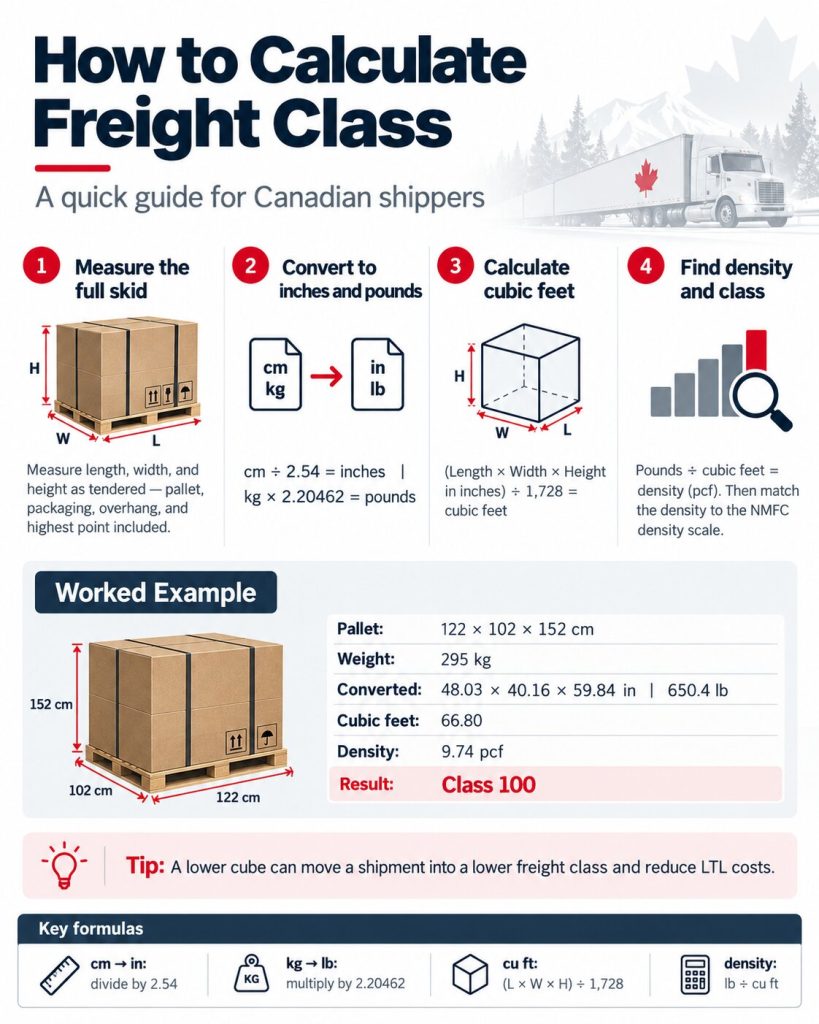
To calculate freight class, measure the handling unit’s length, width, and height in centimetres and convert to inches by dividing by 2.54. Convert weight from kilograms to pounds by multiplying by 2.20462. Multiply the three dimensions in inches and divide by 1,728 to get cubic feet. Divide pounds by cubic feet for density in pounds per cubic foot, then read the class off the density scale.
The calculator above does this for you, but density is the number you control, so it is worth being able to check it yourself.
Length, width, and height of the skid as it will be tendered. Include the pallet. Include the packaging. Include any overhang, and include the highest point on the load, not the average. If a corner of a carton sticks out 5 cm past the pallet edge, the effective width is the wider measurement. Carriers with dimensioners will catch it.
Centimetres to inches: divide by 2.54. Kilograms to pounds: multiply by 2.20462.
Multiply length × width × height in inches, then divide by 1,728.
The result is your density in pounds per cubic foot.
A pallet measures 122 cm long, 102 cm wide, 152 cm high, gross weight 295 kg.
Convert: 48.03 in × 40.16 in × 59.84 in, and 650.4 lb
Cubic feet: (48.03 × 40.16 × 59.84) ÷ 1,728 = 66.80
Density: 650.4 ÷ 66.80 = 9.74 pcf
On the density scale, 9.74 pcf falls in the “8 but less than 10” band, which rates class 100.
Now notice how close that is to a break point. If the same 295 kg had been packed to 137 cm high instead of 152 cm, the cube drops to 60.21 cubic feet and density rises to 10.80 pcf, which crosses into the “10 but less than 12” band at class 92.5. Fifteen centimetres of packing height, one class level. That is the whole argument for measuring before you book instead of after.
This freight class chart is the 13-level density scale that now governs most NMFC commodity entries. Find your density in the second column and read the class in the third. The last column shows the kind of freight that typically falls in each band.
| Sub | Density (pcf) | Class | Typical freight at this density |
| 1 | Less than 1 | 400 | Foam products, empty containers, lampshades |
| 2 | 1 but less than 2 | 300 | Assembled chairs and tables, light wood cabinets |
| 3 | 2 but less than 4 | 250 | Mattresses, upholstered furniture, large TVs |
| 4 | 4 but less than 6 | 175 | Clothing, cushions, boxed plastic housewares |
| 5 | 6 but less than 8 | 125 | Small household appliances |
| 6 | 8 but less than 10 | 100 | Retail shelving, car covers, boxed household goods |
| 7 | 10 but less than 12 | 92.5 | Computers and monitors, refrigerators |
| 8 | 12 but less than 15 | 85 | Crated machinery, cast iron stoves |
| 9 | 15 but less than 22.5 | 70 | Packaged food, automotive parts, engines |
| 10 | 22.5 but less than 30 | 65 | Bottled beverages, books in boxes |
| 11 | 30 but less than 35 | 60 | Boxed hardware, heavy car parts |
| 12 | 35 but less than 50 | 55 | Bricks, hardwood flooring, building materials |
| 13 | 50 or greater | 50 | Bagged cement, steel plate, dense metal parts |
The examples are a guide to what usually sits at each density, not a classification. The same product can land in different bands depending on how it is packed, and some products have their own NMFC item with a fixed class. Confirm the item number before you book.
A metric shortcut worth memorizing: 1 pcf equals roughly 16.02 kg per cubic metre. So 160 kg/m³ is about 10 pcf, and 240 kg/m³ is about 15 pcf. If you think in metric, those two numbers give you a fast sanity check before you do the full conversion.
In July 2025, NMFTA moved roughly 2,000 commodity listings onto the full density scale and added two new classes, 55 and 50, for very dense freight. The practical effect: your class now depends far more on what you measured than on what you are shipping. Products that sat at one fixed class for decades now move with the density of each skid. Dense, well-packed freight got cheaper. Light, bulky, poorly packed freight got more expensive, and carriers invested in dimensioners to catch the difference.
NMFTA’s own data shows why. Its density study on foundry flasks recorded shipments from 0.57 to 39.07 pounds per cubic foot under a single item number. Two shippers sending what the classification called the same product could be using trailer space nearly seventy times differently per pound. A fixed class cannot describe that. A density scale can.
Because carriers rate what they measure, the burden of proof sits with your documentation. A vague bill of lading leaves the carrier to decide how to rate your freight, and that decision rarely goes in your favour.
Per handling unit, not per shipment. List each skid separately with its own dimensions and weight. A single line reading “3 skids, 1,850 lbs” is an invitation to have the whole shipment rated on total cube.
Actual dimensions, including the pallet and any overhang. Measure to the highest and widest points. If you are using a dimensioner, keep the output. If you are not, a tape measure and a habit of measuring every skid before it ships is enough.
The NMFC item number with the correct sub. On density-based items, the sub is the density band. Getting the item right and the sub wrong produces the same reclass as getting both wrong.
A specific commodity description. “Machine parts” is the single most reclassified phrase in LTL. Name the article the way the classification names it.
Every distinct commodity on a mixed pallet, with its own weight and class. If you put differently classed goods on one pallet without listing them separately, the whole pallet is billed at the highest class. If you choose not to itemize, the bill of lading must name the highest-classed article and add the notation “And other articles classed the same or lower,” or “RS or L.”
Pallet and dunnage weight, shown separately. On an itemized mixed pallet, this lets the weight of the pallet and packing material be charged at the lowest qualifying class instead of a higher one.
A unique identifier on each handling unit. “1 of 4,” “2 of 4,” and so on, marked on the unit and matching the BOL. It is not mandatory, but it costs nothing and makes carrier inspections much easier to dispute.
Customs paperwork that agrees with the freight paperwork. Canada Customs Invoice, commercial invoice, and USMCA certificate of origin where applicable. A description mismatch between the customs invoice and the BOL is a common trigger for both border delay and freight inspection. Our team reconciles these before tender rather than after.
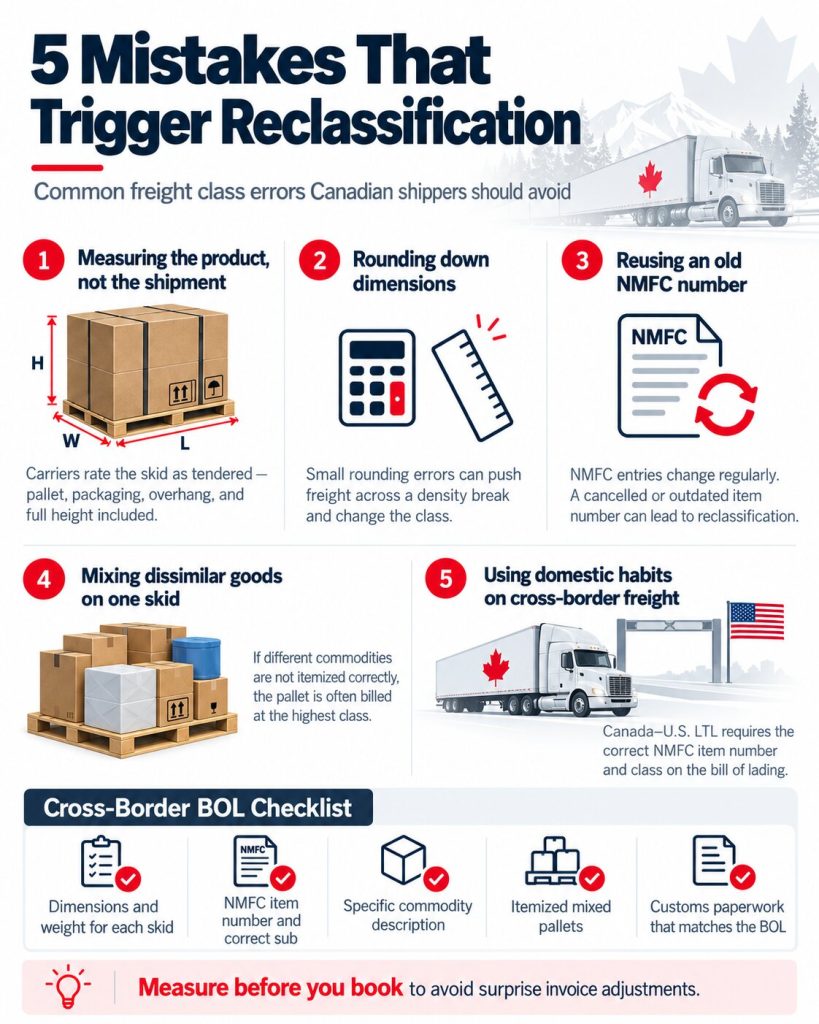
Measuring the product instead of the shipment. The carton is 60 cm tall; the skid with the pallet, the stretch wrap, and the corner boards is 74 cm tall. The carrier measures the second number.
| Conversion | Multiply by |
| Centimetres to inches | ÷ 2.54 |
| Metres to inches | × 39.37 |
| Kilograms to pounds | × 2.20462 |
| Cubic metres to cubic feet | × 35.3147 |
| kg/m³ to pcf | ÷ 16.0185 |
| Cubic inches to cubic feet | ÷ 1,728 |
Reference points: a standard 48 × 40 in pallet is 122 × 102 cm. A Euro pallet at 1200 × 800 mm is 47.2 × 31.5 in. A skid at 160 kg/m³ is about 10 pcf. A skid at 360 kg/m³ is about 22.5 pcf.
Freight class decides what you pay for every LTL pallet that crosses into the United States, and density decides freight class for most products. That makes your tape measure and your scale the most direct way to control what cross-border freight costs.
Before each cross-border shipment, measure the full skid with the pallet and any overhang, run the numbers through the calculator above, confirm the NMFC item number, and list every handling unit separately on the bill of lading. On domestic Canadian lanes, ask your carrier whether it rates by class or by space before you book.
Shippers who do this get quotes that hold. Shippers who skip it find out the real class on the invoice, after the price has already been quoted to the customer.
Just Ship It Logistics has been arranging freight out of Ontario for over 35 years, for small and mid-sized companies that do not have the volume to negotiate directly with carriers or a rate analyst on staff. We confirm the freight class and NMFC item number before your shipment is booked, not after the invoice arrives, and we handle the cross-border customs paperwork alongside the freight so the two documents agree.
Both. The NMFC originates as a U.S. standard and governs virtually all Canada - U.S. cross-border LTL, because that freight moves on U.S. carrier tariffs. Within Canada it is widely referenced but not universal: some domestic carriers rate on NMFC class, others on cubic or dimensional weight, linear feet, or skid count under their own tariffs. Ask your carrier which basis applies to the lane.
The authoritative source is NMFTA's ClassIT+ database, which is a paid subscription. The free public lookup tool has been retired. Most shippers get their item numbers from their freight partner or 3PL, who verifies against ClassIT+ before the shipment is booked.
The carrier reclassifies the shipment and issues a revised invoice, usually with an inspection fee added. The difference is billed after delivery, which means it lands on freight you have already quoted to a customer. Reclassification is the most common billing adjustment in LTL and nearly all of it is preventable at the loading dock.
Yes. The Docket 2026-1 supplement took effect May 23, 2026, consolidating named commodity items into density-based items across springs, semiconductors, jewelry, artwork, silver flatware, foundry flasks, elevator parts, filters, pharmaceuticals, office machines, and more. A further supplement takes effect December 12, 2026.
A freight class calculator is accurate for density, which is the factor that determines class for most commodities under the current NMFC. It cannot assess stowability, handling, or liability, so any commodity with an item-specific listing that flags one of those may class differently from what the density suggests. Use the calculated class to sanity-check a quote and to compare packing configurations, then confirm the item number before tendering.
Almost always, on density-based items. Lower density means fewer pounds per cubic foot, which means a higher class and a higher rate per pound. The exception is commodities with handling, stowability, or liability flags, which are not rated purely on density and can carry a high class regardless of how well they are packed.